· 4 min read
Do Older Numerai Models Score Better? Age vs Performance
Updated
Historical scope reviewed September 8, 2026. Age measures how long a model slot has been observed, not the age of its current uploaded strategy. Retrospective cohort survival and score-generation changes can produce an apparent age effect. The result is descriptive rather than causal. See the current metric definitions.
Intuition says a Numerai model that has survived five years of rounds should outperform a three-month-old newcomer. The data says the opposite. Across roughly 4.3 million staked model-round observations in the Classic tournament (every scored round joined to the model’s start_date), models in their first six months post the best mean MMC, the best payout per staked NMR, and the only better-than-coin-flip hit rate. After that, almost every measure decays with age.
MMC (Meta Model Contribution) is the primary payout metric: it rewards predictions that improve the meta-model after accounting for what everyone else already submitted. That definition matters for everything below, because it makes originality — not raw accuracy — the thing that ages.
The Inverted Experience Curve
Group every staked model-round by the model’s age on the round’s close date, in half-year buckets. The pattern is immediate.
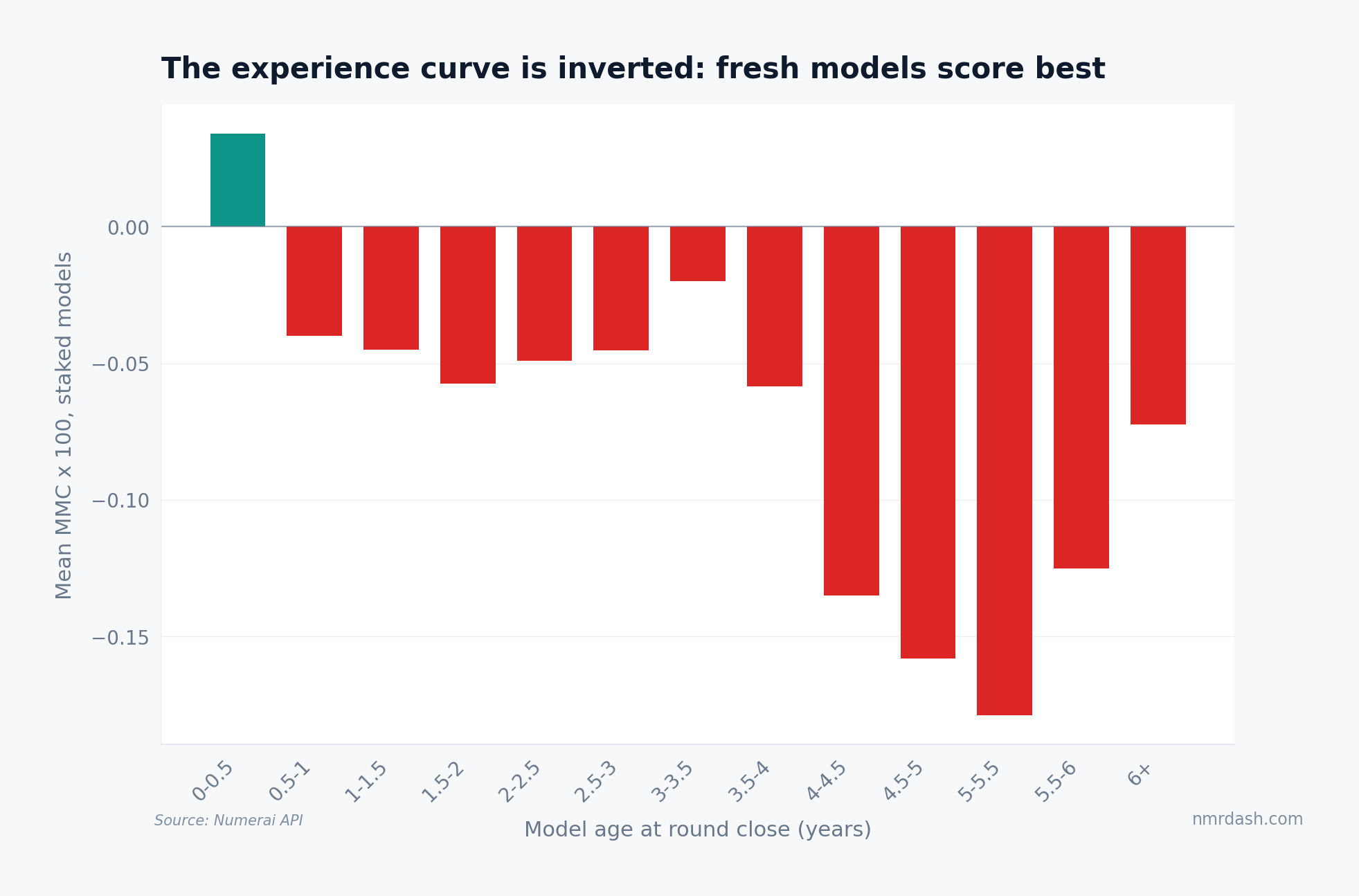
The 0-0.5 year bucket is the only one with positive mean MMC (+0.0003 across 807K observations). From six months onward the mean sits between -0.0004 and -0.0006 for a few years, then deteriorates sharply: models aged 4.5-5.5 years average around -0.0016 to -0.0018. These are small numbers per round, but they compound across hundreds of rounds and thousands of models, and the payout engine multiplies them directly into NMR.
The Money Agrees
Scores could in principle diverge from payouts, since payouts blend MMC with a correlation metric and per-round payout factors. They don’t diverge much.
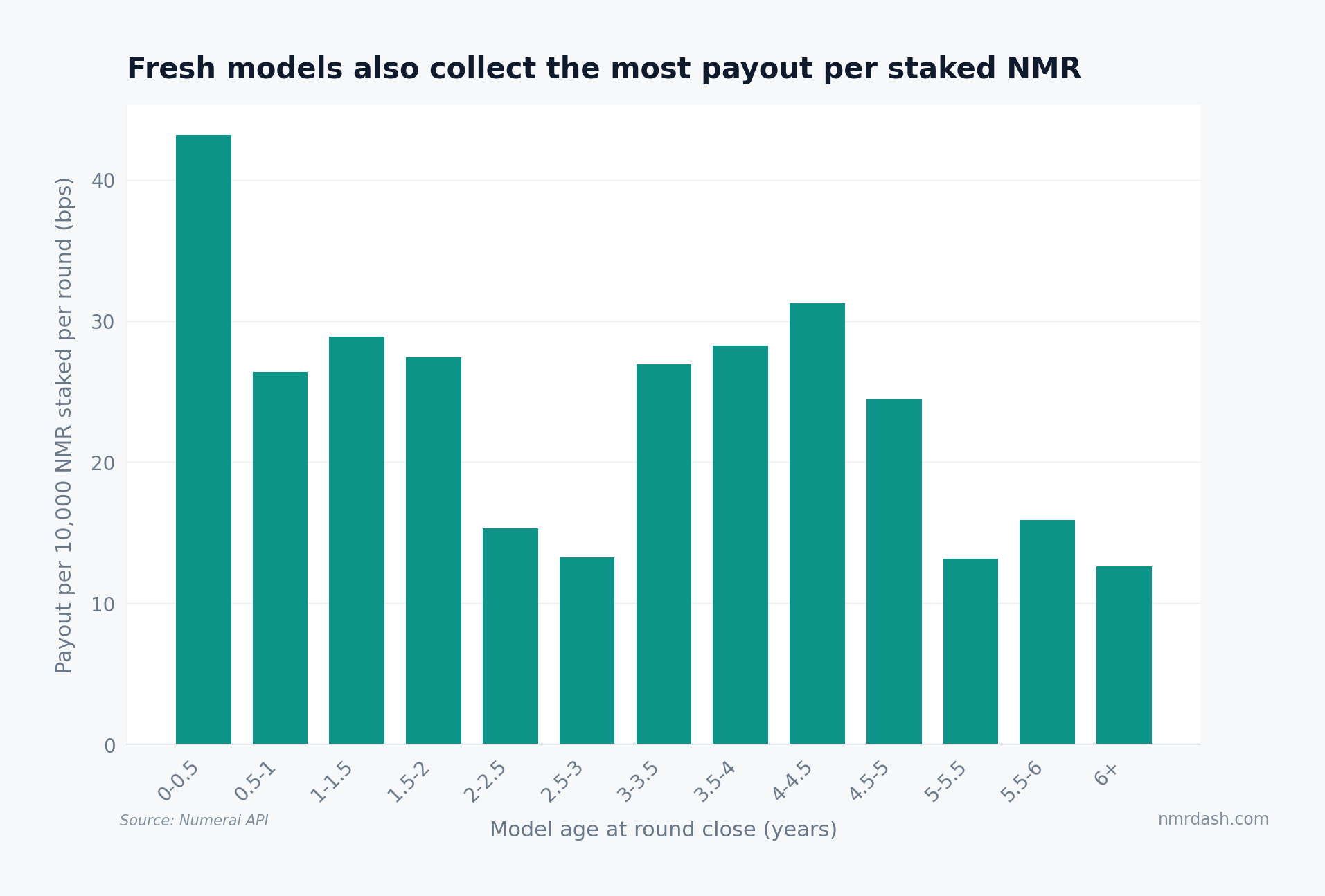
Models under six months old earned about 43 bps per round per 10,000 NMR staked, roughly 40% more than any other age group. The middle of the curve is noisier (the 3.5-4.5 year buckets bounce back to 28-31 bps), but both ends agree with the MMC story: the freshest models earn the most, and the oldest cohorts (5.5+ years) collect 13-16 bps, roughly a third of the newcomer rate. Payout ROI by stake tier slices the same payout data by stake size instead of age.
Same Models, Tracked Through Time
Cross-sectional age buckets have a selection problem: the set of five-year-old models is not a random sample of models that were once young. To control for it, take only models that stayed staked into at least their fourth year and follow that fixed group through its own life.
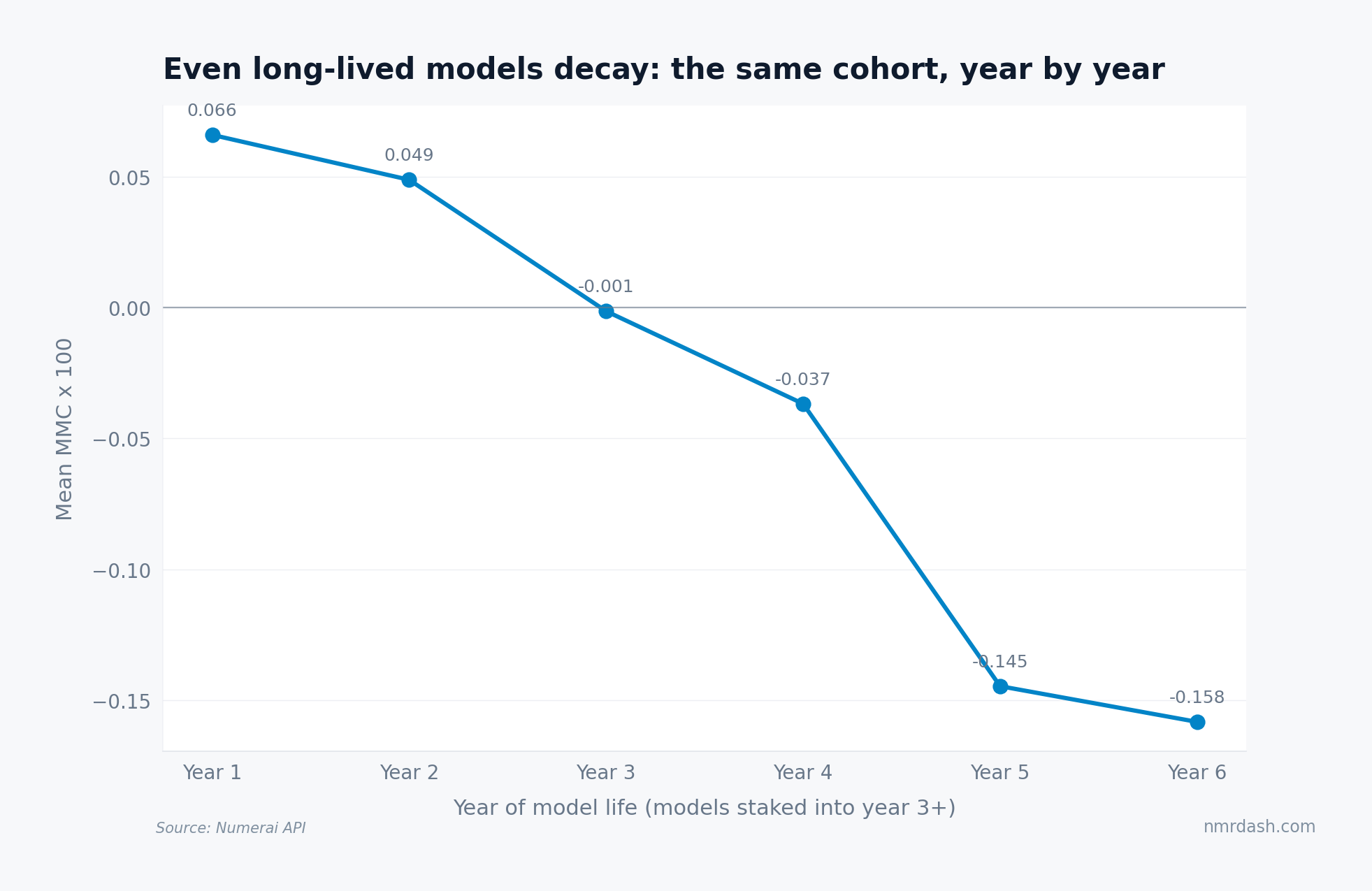
The decay survives. The same long-lived models that averaged +0.00066 MMC in their first year drift to roughly zero in year three and -0.0016 by year six. This is not “bad models die young and drag down the old buckets”; these are the survivors, and they still decay. The pattern is consistent with staleness: a model trained once and left running competes against a meta-model that keeps absorbing new signal, so its marginal contribution erodes even if its raw predictions are unchanged. The metric convergence post documents the same crowding force from a different angle.
Hit Rates Slide Below the Coin Flip
Averages can hide a few disasters. Hit rate — the share of staked rounds with positive MMC — checks whether typical rounds decay too.
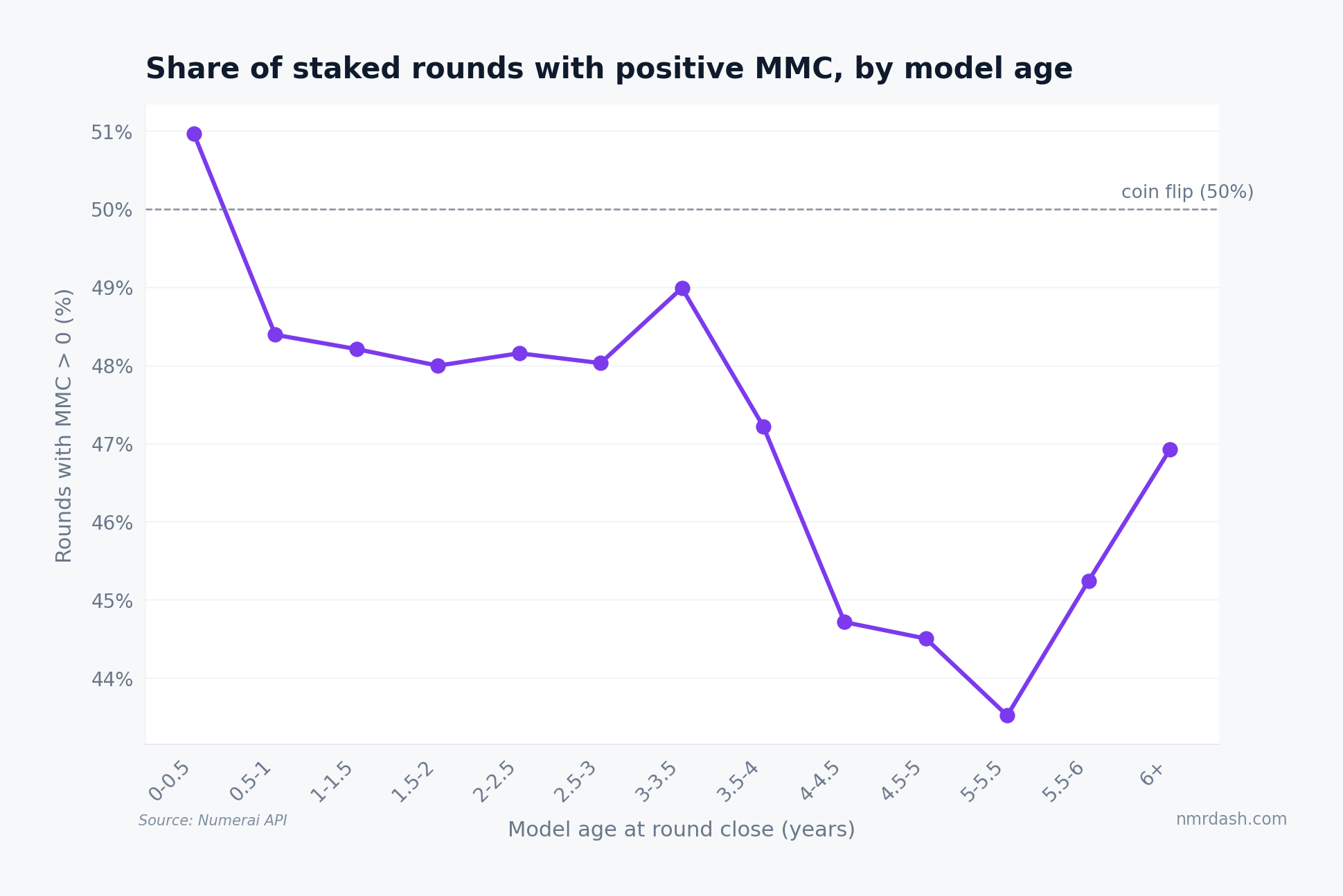
Models under six months old land positive MMC in 51% of staked rounds. The rate slips to about 48% through the middle years and bottoms near 43.5% for models around five years old. A staked round from an old model is closer to a weighted coin that lands tails 56% of the time, and the payout engine charges for tails.
What to Do With This
Three readings, in decreasing order of comfort. First, retraining matters: the within-model decay suggests a model’s edge has a shelf life of roughly two to three years, so treating a live model as finished is a slow leak. Second, the newcomer premium is partly selection — people launch a new slot when they believe they have something better, so young models embody their builders’ best current ideas, while old slots often run on autopilot. Third, for stake allocation the age of the idea is what counts: an old account uploading a freshly retrained pipeline is young in the sense that matters here.
The stake-weighted age study finds that the sampled tournament capital sits on models averaging several years old. Read that result alongside the age-performance curves above when evaluating what a model slot’s age tells you about its strategy. For how model death (rather than decay) plays out, see Model Survival.