· 9 min read
Numerai's Biggest New-User Wave Since 2021
Updated
Historical scope reviewed September 8, 2026. New accounts, new model slots and first positive stakes are different events. Current ownership backjoins and the original NMR threshold affect the historical cohorts. The figures do not classify migration transfers as new investors or atomic fractional stakes as inactivity. See the current metric definitions.
Numerai’s front door is busier than it has been in five years. In the first half of 2026, 5,244 new models made their first Classic submission, more than triple the pace of the same period in 2025, and Q1 alone brought 492 first-time accounts, the most in any quarter since the 2021 bull run. The wave behaves nothing like 2021’s, though: it arrives fully automated, submits to essentially every open round, mostly never stakes, and one slice of it was a disposable model farm that vanished within weeks.
The number I keep coming back to is 42. That is how many Q1 2026 arrivals put at least 1 NMR at stake within 90 days of showing up, the most new staking accounts minted in a single quarter since early 2022. For a tournament whose capital base has been aging for years, that quiet replenishment matters more than any headline participation count.
New models are arriving at triple the 2025 pace
Tag every new model by the age of the account it belongs to on the day of its first scored round, and the composition of the wave is immediate.
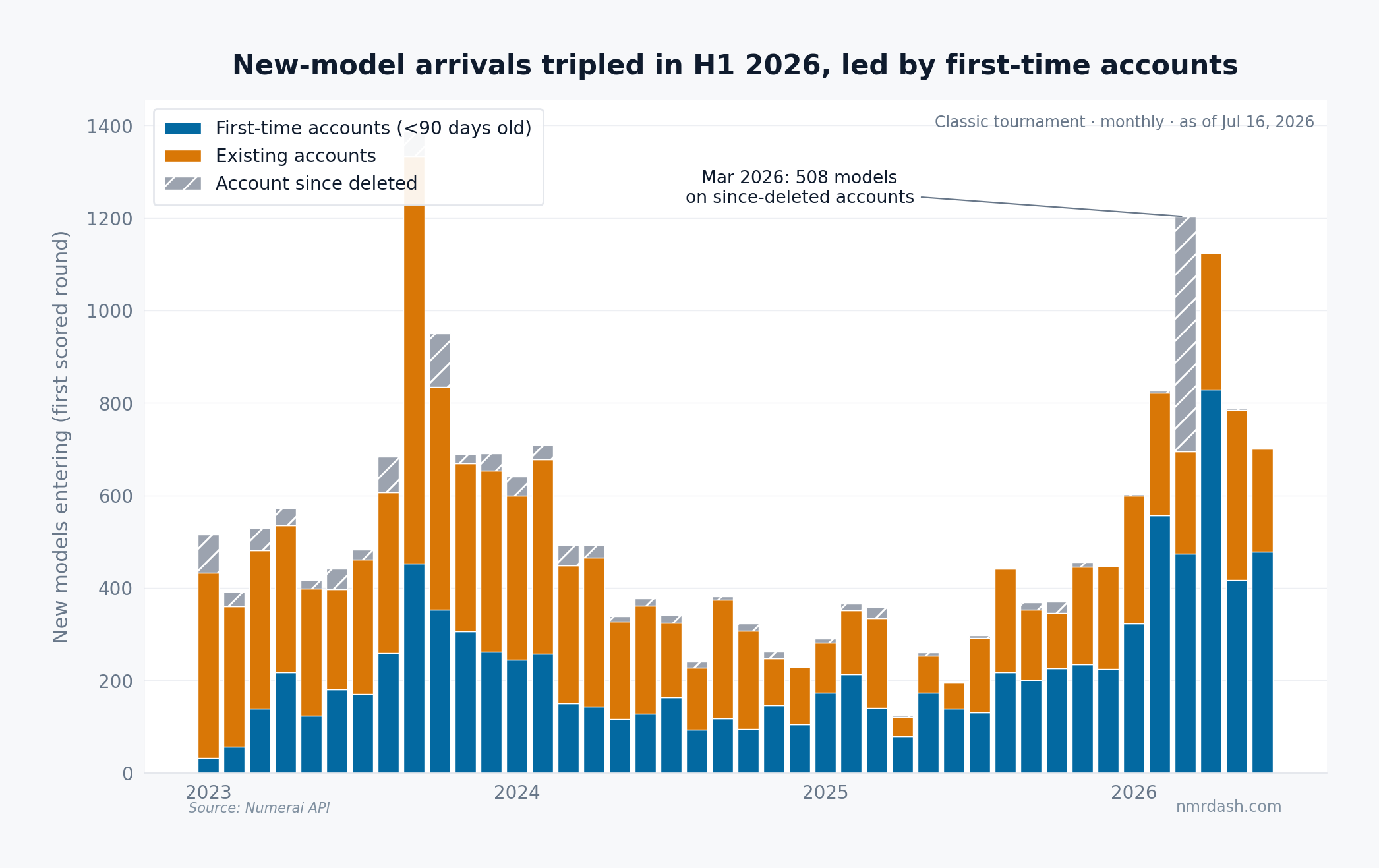
Through 2024 and 2025, entries ran a few hundred models a month (the late-2023 spike was the 0.1 NMR onboarding-credit era, not organic growth). Since December 2025 every month has cleared 440, and first-time accounts supplied 59% of the H1 2026 total, with the rest split between existing accounts adding slots and a since-deleted sliver. Veterans are expanding too, but new people are the larger share, which is the opposite of what I expected when I started pulling these numbers.
The most new accounts since the 2021 bull run
Collapsing models to accounts and counting first submissions per quarter puts the wave in seven-year context.
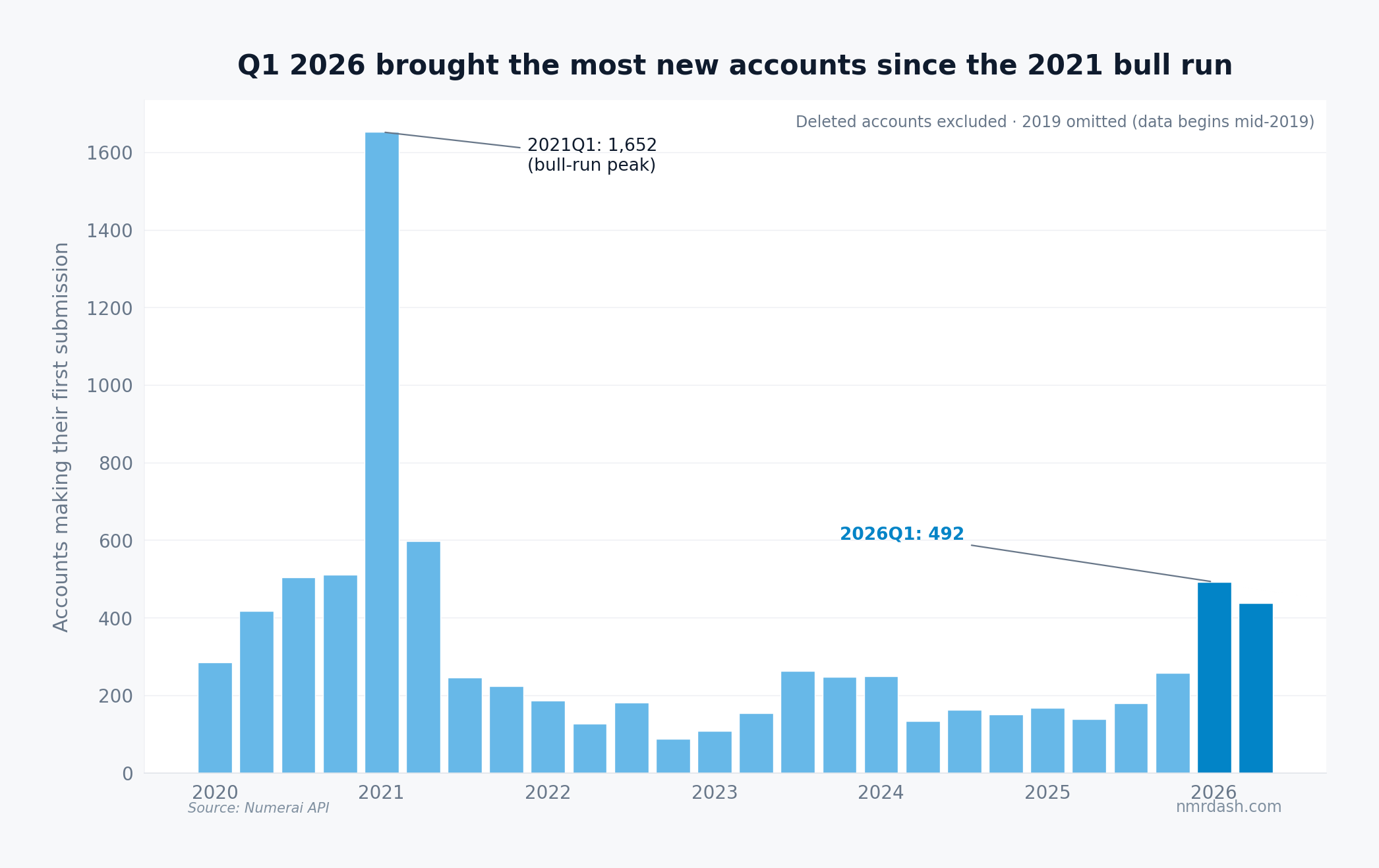
From 2022 through 2025, new-account arrivals stayed rangebound between 87 and 262 per quarter. Q1 2026 broke the band with 492, Q2 held 438, and the half together exceeded all of 2025. The scale is still nothing like the mania quarter of early 2021, which brought 1,652 accounts, but the regime change is unmistakable. I can’t point to a single cause in this data; NMR’s price did nothing in H1 that would explain it, and no referral event is visible except the March anomaly below. My best guess is the tooling story behind the no-stake submission surge: LLM-assisted pipelines have made “download data, submit predictions” a one-evening project.
March’s spike was mostly a disposable model farm
One month of the wave deserves an asterisk the size of the bar itself. March 2026 logged 1,203 new models, and 508 of them belong to accounts that no longer exist. The deleted set has a machine’s fingerprints: naming grammars like n19_lgb_n040 and n26_xgb_dart (algorithm-by-hyperparameter sweep IDs), with 329 of the models entering on March 21 alone. This was a small number of operators, possibly one, manufacturing a fleet on burner accounts and walking away.
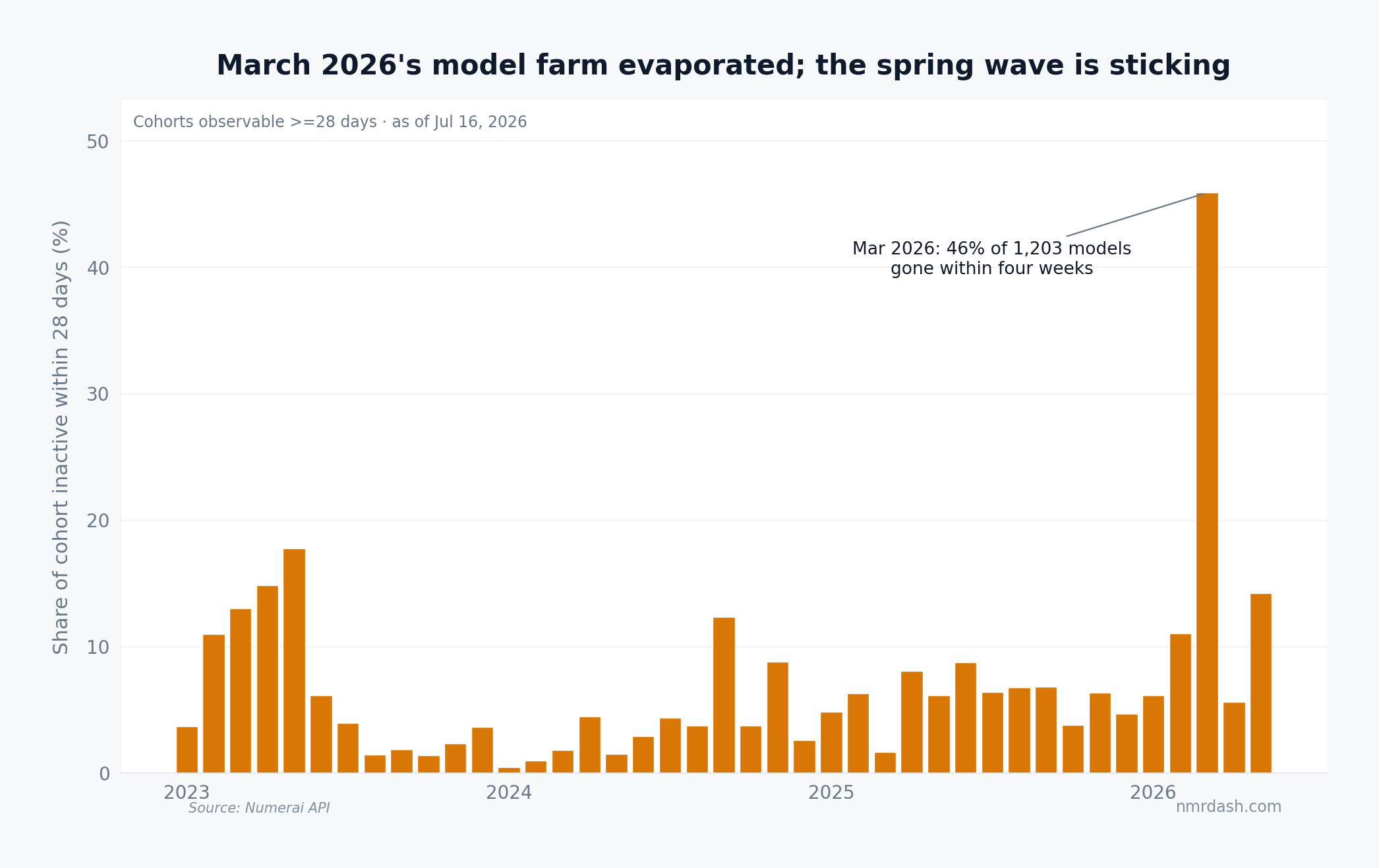
The attrition chart shows how fast it unwound: 46% of March’s models were inactive within four weeks, against a 2024–2025 norm of 2–9%, and just 8.6% of the cohort ever staked. The spring cohorts look nothing like that. April’s four-week evaporation was 5.6%, May’s was 14%, and nine in ten April–June arrivals were still submitting within 30 days of mid-July. Strip the farm out entirely and H1 2026 still runs about 2.5 times 2025’s entry pace, so the wave survives its own asterisk.
The survivors behave like infrastructure, not hobbyists. The median H1 2026 arrival submits 5.1 rounds per week, effectively every round Numerai opens, from its first week of life, and its early CORJ60 lands within a few thousandths of the field median. Nobody is hand-uploading CSVs on Saturday mornings anymore; new users arrive with a pipeline already wired to a benchmark-quality template.
Conversion didn’t collapse; volume now does the work
The bleakest read on modern cohorts is that they never stake, and by share that is true: about nine in ten recent arrivals have put nothing at risk. But the staking funnel’s rate has not actually deteriorated, and at this volume the rate is no longer the binding constraint.
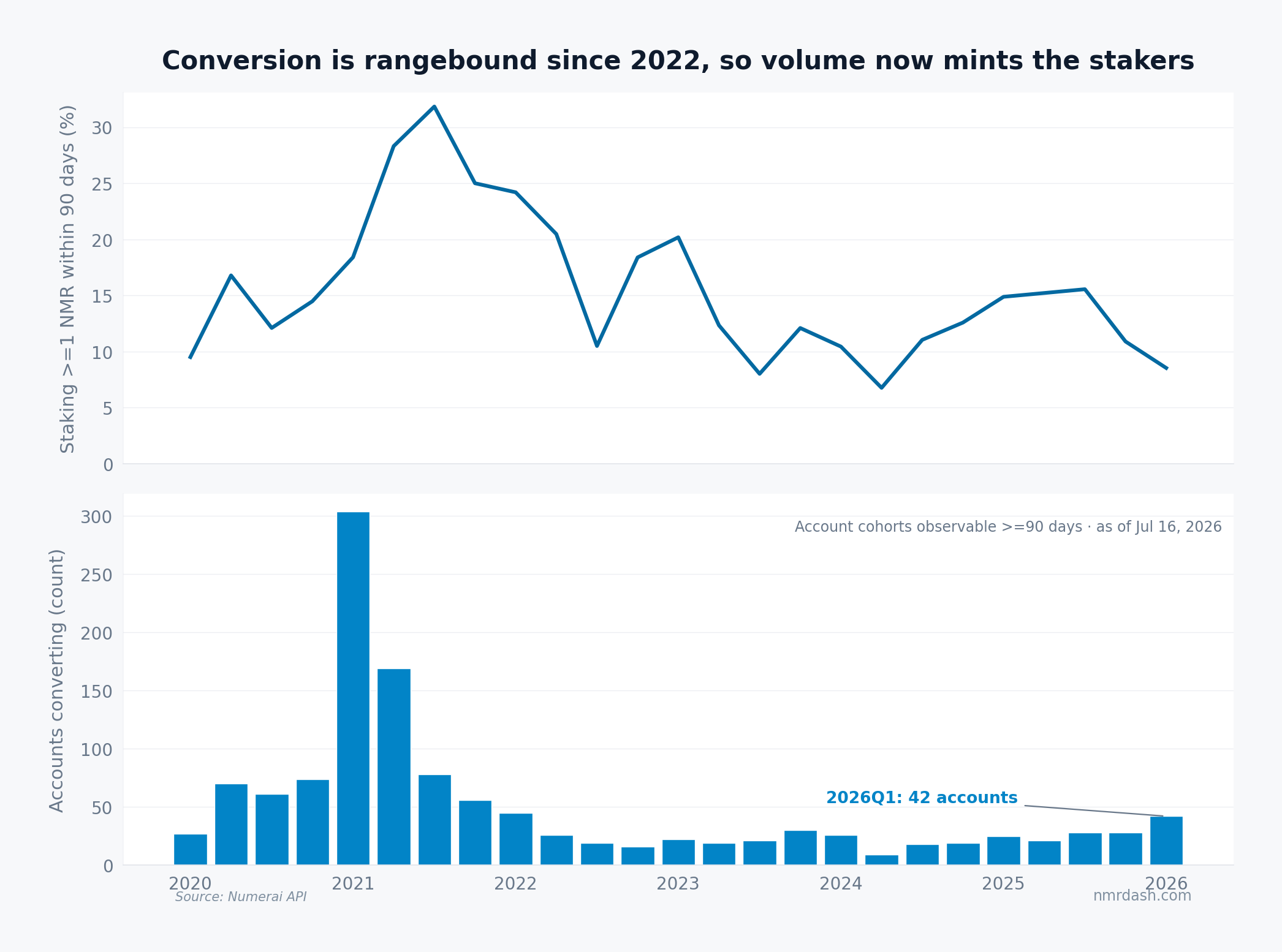
Since 2022 the share of new accounts reaching a 1 NMR stake within 90 days has oscillated between 7% and 20% with no trend. Q1 2026 came in at 8.5%, the low end of the range and unsurprising for a cohort diluted by a model farm, yet on 492 arrivals that still minted 42 new stakers: the most in any quarter since early 2022, and nearly double the recent norm of about 23. The monthly trail confirms the dip was the farm, not the wave: January converted at 8.5% and farm-heavy February at 6.5%, then March reached 11.8% and April 16.3%, the best monthly print in a year.
This is the reconciliation with the account lifecycle post’s gloomier funnel: both are true. Conversion percentages remain far below the 2021 era, and most newcomers will stay spectators forever. What changed in 2026 is the top of the funnel: with three times the arrivals, the same leaky funnel now drips faster than it has in four years.
The rate held, but the conviction collapsed
Watching cohorts longer doesn’t change that read: since 2020, no entry year has added more than five points of conversion between day 90 and day 365, so the first-quarter rate is the story, for this wave as for every prior one. Converts also stick like they always have: roughly 80% of every era’s 90-day converts are still staking two to three months after their first stake, including 34 of the wave’s first 42. What has changed generation over generation is what a conversion is worth.
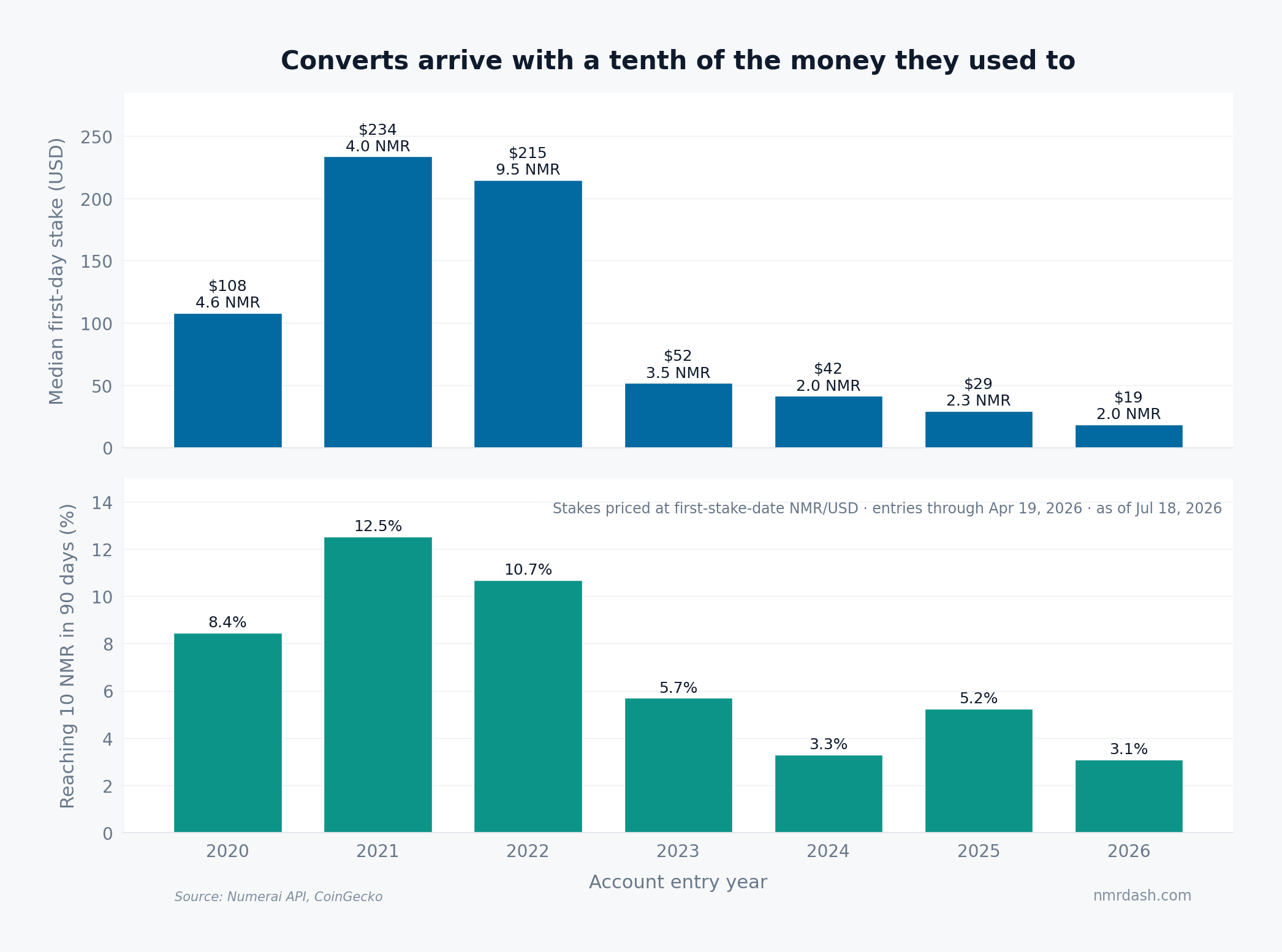
The 2021 convert opened with a median 4 NMR, about $234 at the time; the 2026 convert opens with 2 NMR, about $19. Priced at stake-date NMR, first-day conviction is down roughly 90% in five years, and it is not just the token’s price: the escalation pipeline thinned too, with the share of a cohort putting 10 NMR at risk within its first quarter falling from 12.5% (2021) to 3.1%. The odd year out is 2022, whose few converts arrived with the largest stakes in the data (median 9.5 NMR); bear-market cohorts are small but committed. This is also the missing piece behind the vintage chart below — a 2026-vintage staked model’s median stake is 3.8 NMR because that is all its owner put in.
So the wave replenishes headcount, not capital: the same funnel probability, the same stickiness, a tenth of the money per convert. For this generation to matter to the staked pool, its converts have to scale up after proving out the way earlier classes did, or the headcount has to keep compounding.
A fifth of the staked pool already rides on 2025–26 models
Staking is where the wave should matter, so weigh each vintage by the NMR it actually has at risk.
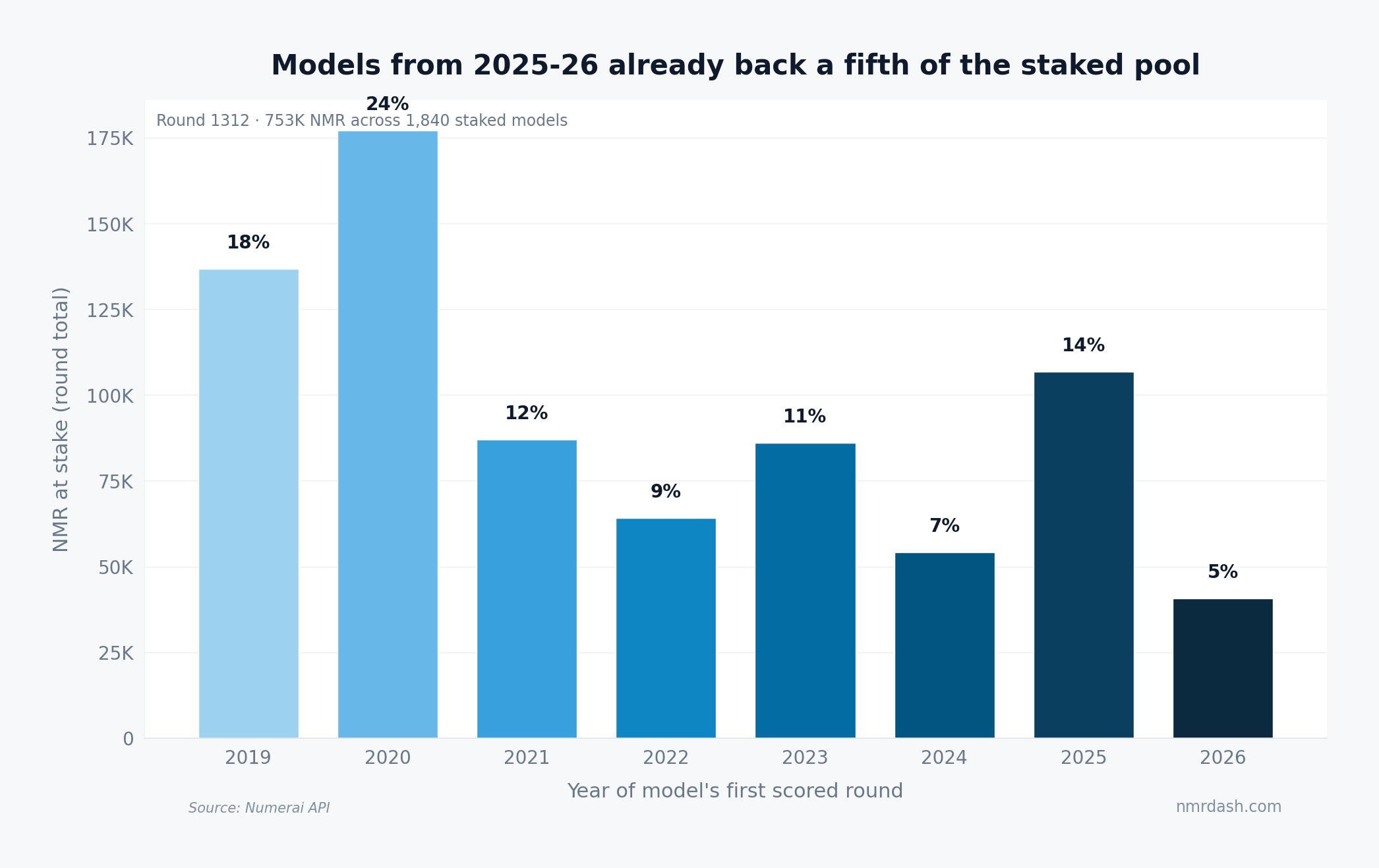
In round 1312 (early July 2026), models that debuted in 2025–26 backed a fifth of the 753K NMR at stake. The count-versus-capital gap is the striking part: 2026-vintage models are already 24% of all staked models, but their median stake is 3.8 NMR, against 151 NMR for the 2019 vintage. And model vintage is not account vintage. The lifecycle data showed accounts from the last 18 months hold only about 5% of the pool, so much of this fresh-model stake is veterans rotating capital onto new slots, which is exactly what the age-performance data says they should do: models under six months old post the best MMC and payout per NMR.
For a staker the practical read is about the competition: the meta-model is refreshing much faster than the account-age statistics suggest. A quarter of the staked field debuted this year, running current ideas on automated pipelines. The survival odds say most of them wash out, but the ones that stay are the crowd your model has to beat for MMC.
What would change this read
Three series will confirm or kill this by year-end. First, spring-cohort retention: May’s four-week evaporation already wobbled to 14%, and if the April–June cohorts decay toward March’s pattern over the summer, the wave was churn with a lag, not adoption. Second, Q2 conversion when the quarter fully matures in early October: anything holding above 10% on the full cohort confirms that volume is genuinely minting stakers, while a print below Q1’s 8.5% weakens it. Third, the arrival rate itself: a fall back under roughly 250 new accounts a quarter would date-stamp this as an H1 2026 event rather than a new regime. I’ll check all three when Q3 closes.
Method notes: Classic tournament only; benchmark rows excluded. A model’s entry is its first scored round in the performance data, which begins mid-2019, so pre-existing models are truncated and 2019 is omitted from cohort charts. Accounts group models by account_name; deleted profiles are unattributable and appear only as the “account since deleted” segment, excluded from account counts and conversion rates, which understates the March 2026 anomaly in account terms. Staking means a round with at least 1 NMR of selected stake, excluding the 2023–24 onboarding credits documented in the account-lifecycle post. “Inactive within 28 days” is measured only for cohorts with a full 28-day observation window. Early-score comparisons use each model’s first 20 scored rounds against per-round field medians; scores for rounds younger than about 100 days are still provisional. Stake-by-vintage uses round 1312. The conversion-depth exhibit prices each convert’s first-day account stake at the nearest daily NMR/USD close (CoinGecko) and covers entries through mid-April 2026; convert persistence is a staked round 60–90 days after the first stake. Chart data as of July 16, 2026; the conversion-depth exhibit and monthly conversion figures as of July 18.