· 8 min read
Numerai Account Lifecycle: Who Stakes and What They Earn
Updated
Historical scope reviewed September 8, 2026. Account cohorts inherit the original model-to-account mapping and observation coverage. Model transfers, account absorption and contract migration can mimic entrants or exits. Positive fractional atomic stakes must count; changes in allocation are not verified external flows. See the current metric definitions.
Every Numerai account starts the same way: sign up, download the data, upload predictions. Staking NMR, the step that feeds the meta-model and earns or burns real money, is optional, and the data says it is the exception. Of the 9,056 accounts that have ever submitted to the Classic tournament, 62% never staked anything. Only 22.6% (2,046 accounts) ever put as much as 1 NMR on a prediction, and fewer than one in ten ever crossed 100 NMR. At the other end of the funnel, the entire staked pool of roughly 740,000 NMR sits on about 600 accounts today.
So yes: almost everyone starts as a no-stake account, and most stay that way forever. This post follows the ones who don’t: when they convert, what drives the decision, how their stakes scale afterward, and what each yearly “class” of new stakers earned in its first twelve months. An account here is the account_name behind a model profile; the 41,672 models ever scored in Classic collapse to those 9,056 accounts.
Most accounts never stake, and each generation converts less
Group accounts by the year of their first submission, then by the highest stake they ever reached:
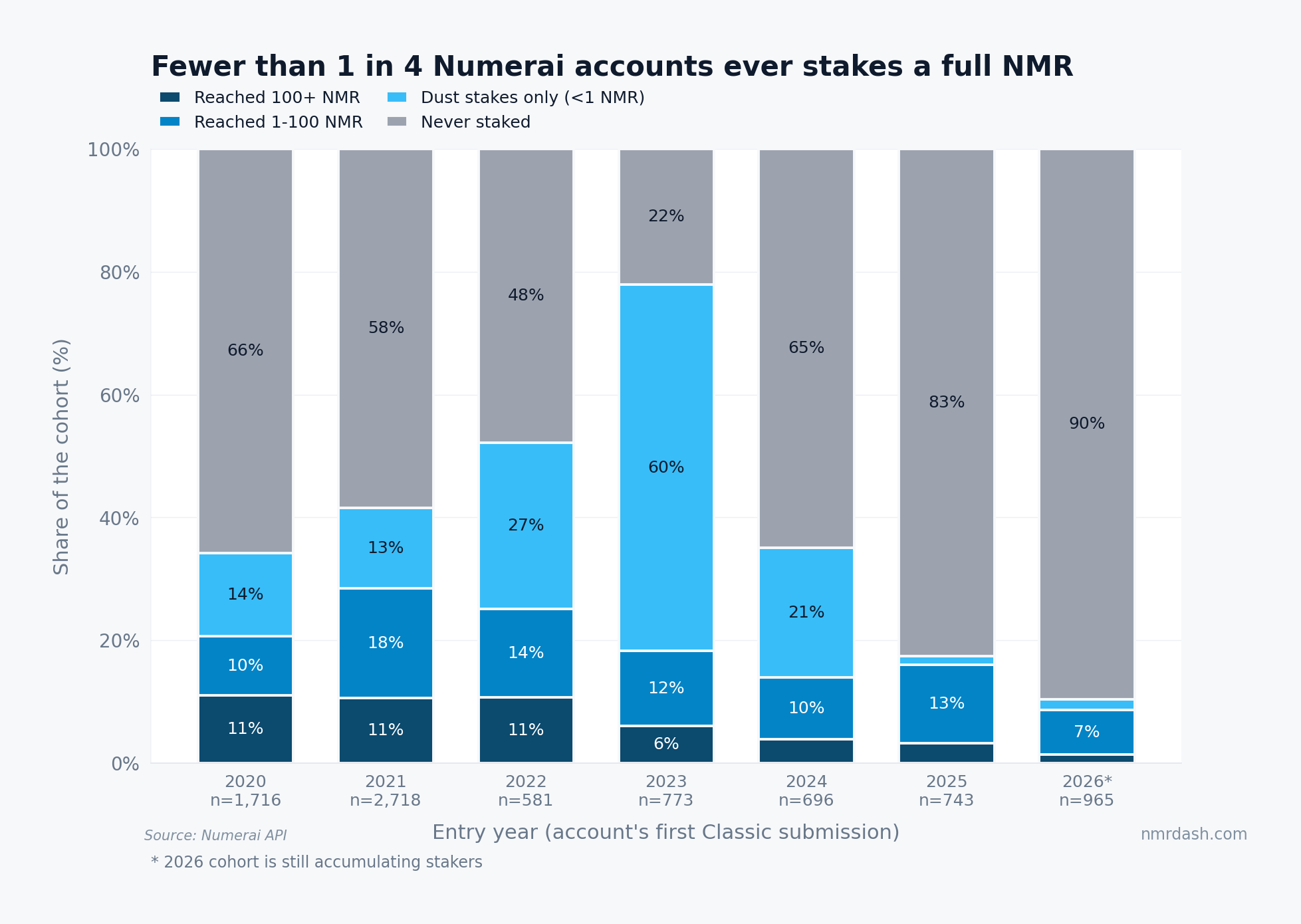
The class of 2021 was the high-water mark: 29% of its 2,718 accounts eventually staked at least 1 NMR, and 11% reached 100+. From there the funnel narrows with every generation: 16% of 2025 arrivals have reached 1 NMR so far, and the 100+ tier has thinned from 11% (2020–2022) to 3–4% (2024–2025) to about 1% of the still-young 2026 cohort. The no-stake submission surge documented this from the submission side; seen from the account side, the “submit first, decide later (or never)” default is now nine out of ten newcomers.
The 2023 bar needs its own explanation. That year 60% of new accounts ended up in the dust tier because Numerai’s onboarding tutorial handed new users 0.1 NMR in stake credits for uploading a first model. The fingerprint is unmistakable: from July 2023 through March 2024, roughly nine in ten new accounts placed a stake within a week, the median first stake was exactly 0.10 NMR, and the median lifetime peak for those accounts never got past 0.16 NMR, about two dollars. It was an onboarding nudge, not conviction, which is why every other chart in this post counts staking only from 1 NMR up.
The trial is short, and the decision comes early
For the accounts that do convert, how long is the gap between first submission and first real stake? Survival-analysis curves (which only count each account while it can actually be observed) put a precise shape on it:
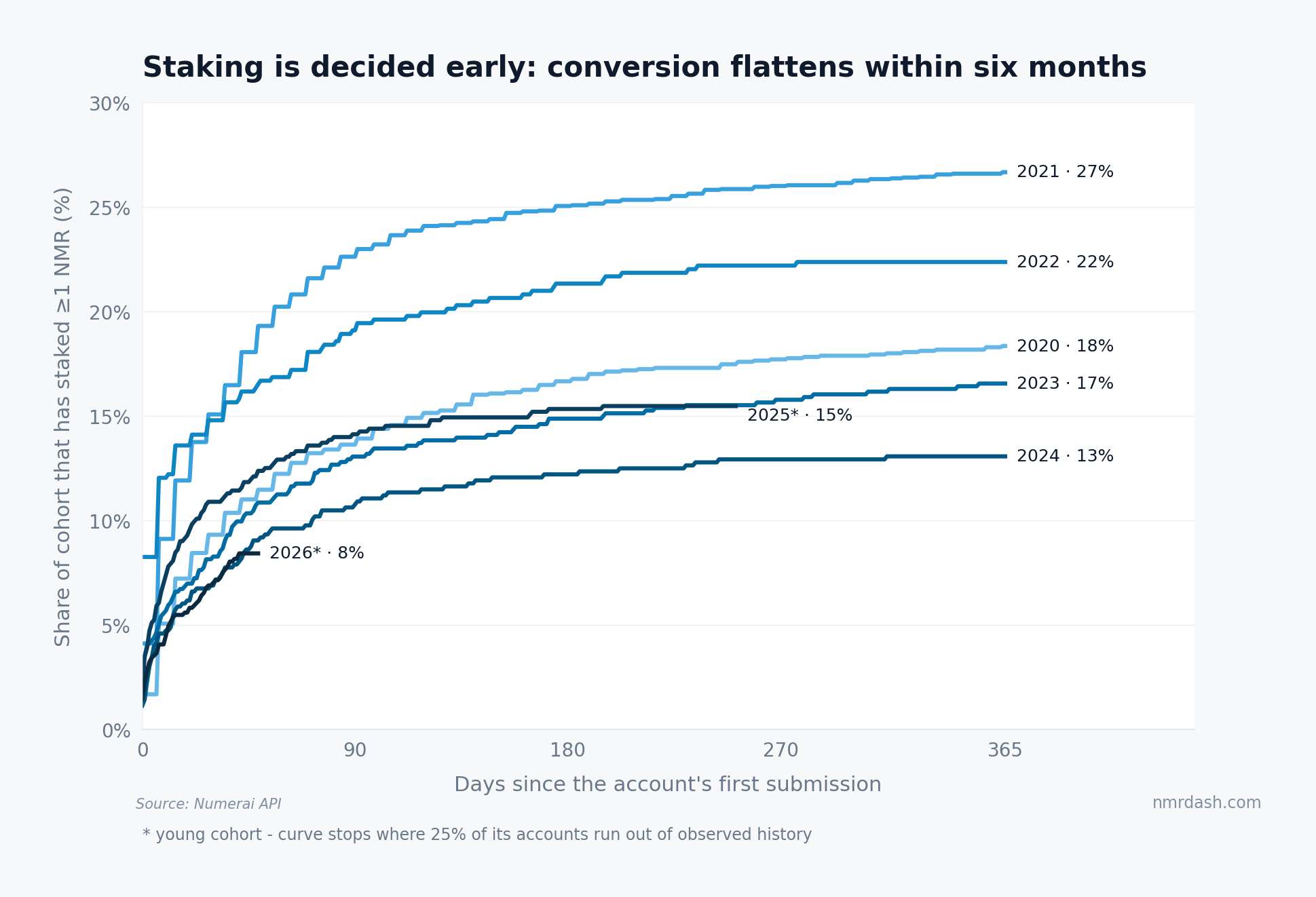
Three things stand out. First, converts decide fast: the median gap from first submission to first ≥1 NMR stake is 35 days, 29% of converts cross within a week, and 69% within three months. Recent converts move even faster (median 13 days for 2025 arrivals, 10 for 2026), which fits the intent story: the few who stake now arrive planning to. Second, every curve goes flat between month three and month six. An account that hasn’t staked by month six almost certainly never will; the 2024 cohort added barely a point of conversion in its entire second half-year. Third, the era shift is visible at day zero: in the weekly-round 2020 era, 8% of accounts staked ≥1 NMR in their very first round, the old “stake to play” norm. Modern cohorts start below 3%.
Scoreboard results no longer drive the decision
The obvious hypothesis is that unstaked accounts are running a trial: submit for a month, check the scores, stake if they’re good. That was once true. Take every account that stayed unstaked for at least 14 days while logging ten or more scored submissions in its first 28 days, grade its trial-month CORJ60 against the field round by round, and check whether it later staked:
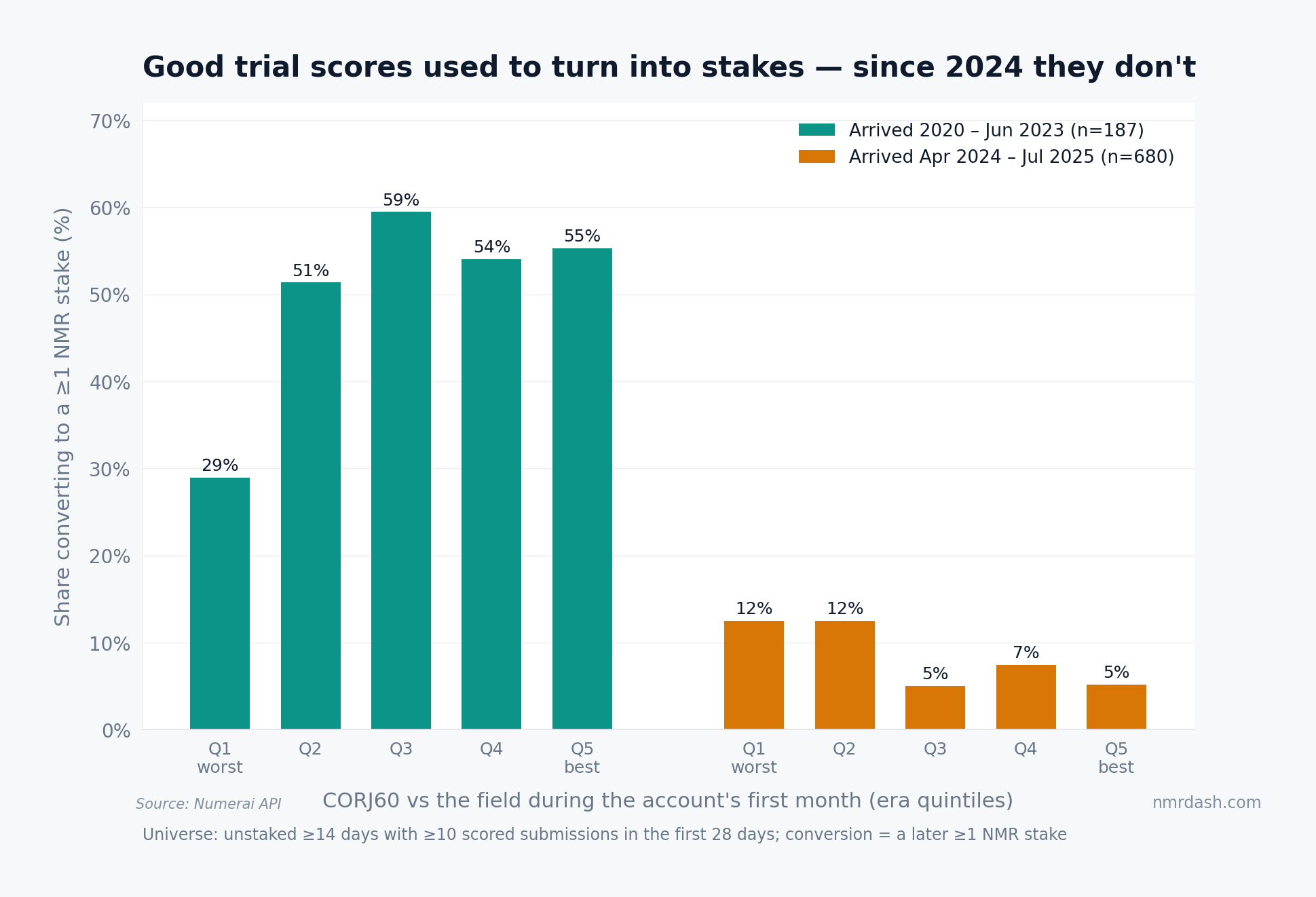
Among 2020 – mid-2023 arrivals, performance clearly mattered: bottom-quintile trial scores converted at 29%, everything above that at 51–59%. Among arrivals since April 2024 the relationship is gone, and if anything inverted. Overall conversion in this trial population collapsed to 8.5% (58 of 680 accounts), and the best-scoring quintile converts at 5% while the worst converts at 12%.
Two readings fit. The staking decision now precedes the evidence: people who intend to stake do it within days, so the long-trial population is dominated by accounts that never planned to stake, and their scores are irrelevant. And high trial CORJ60 increasingly identifies forks of the official example and benchmark pipelines (strong correlation, zero intent) while payouts have moved to MMC, where raw correlation mostly signals crowding. Either way, the tournament’s old conversion engine (good early scores turning into skin in the game) has stalled. The convert counts are small (58 accounts in the recent era), so treat the inversion as directional; the collapse in the level is not ambiguous.
Stakes start small and scale only after proof
Conversion is not the end of the lifecycle; stake sizing has its own arc. Anchor every converting account at its first ≥1 NMR stake and track the median account stake forward, split by where the account ultimately peaked:
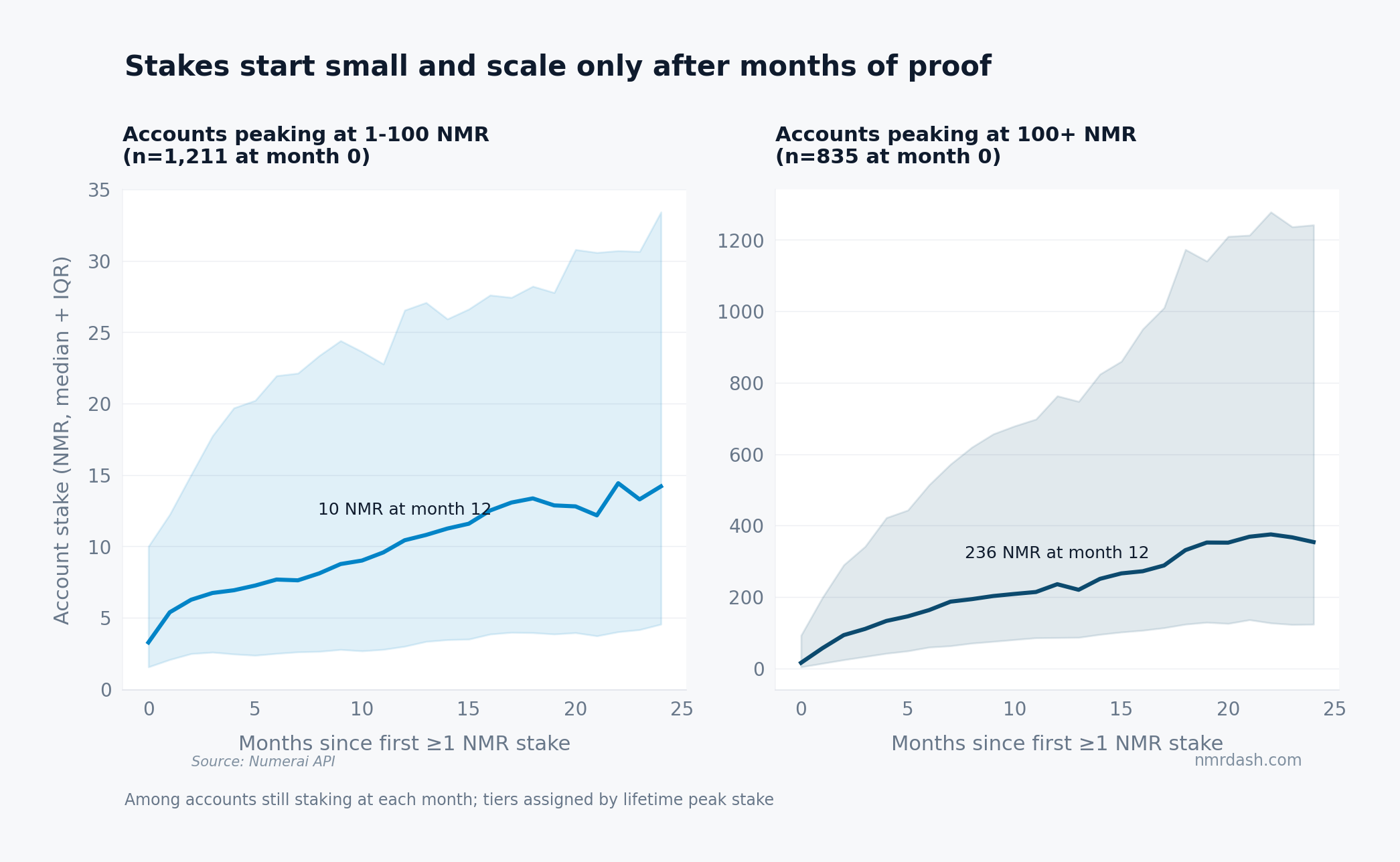
Even the eventual heavyweights start small: accounts that later crossed 100 NMR began at a median of 15.5 NMR, then scaled roughly 7x by month three (110 NMR), 15x by month twelve (236 NMR), and kept climbing past 350 NMR in year two. The modest tier ramps too, just flatter: from about 3 NMR to 10 by the first anniversary. Both curves are conditional on survival (of 835 accounts that ever reached 100 NMR, 659 were still staking at month twelve and 491 at month twenty-four), so read them as the trajectory of the ones who stayed. Staying is itself tier-dependent: about a third of the 100+ accounts have staked within the past 30 days, versus 23% of the 1–100 tier and 4% of the dust tier. Model survival covers the exit side of that story.
Each class earned less than the last — until 2025 lost
Finally, performance by cohort: what did each staking class (accounts grouped by the year of their first ≥1 NMR stake) earn in its first twelve months?
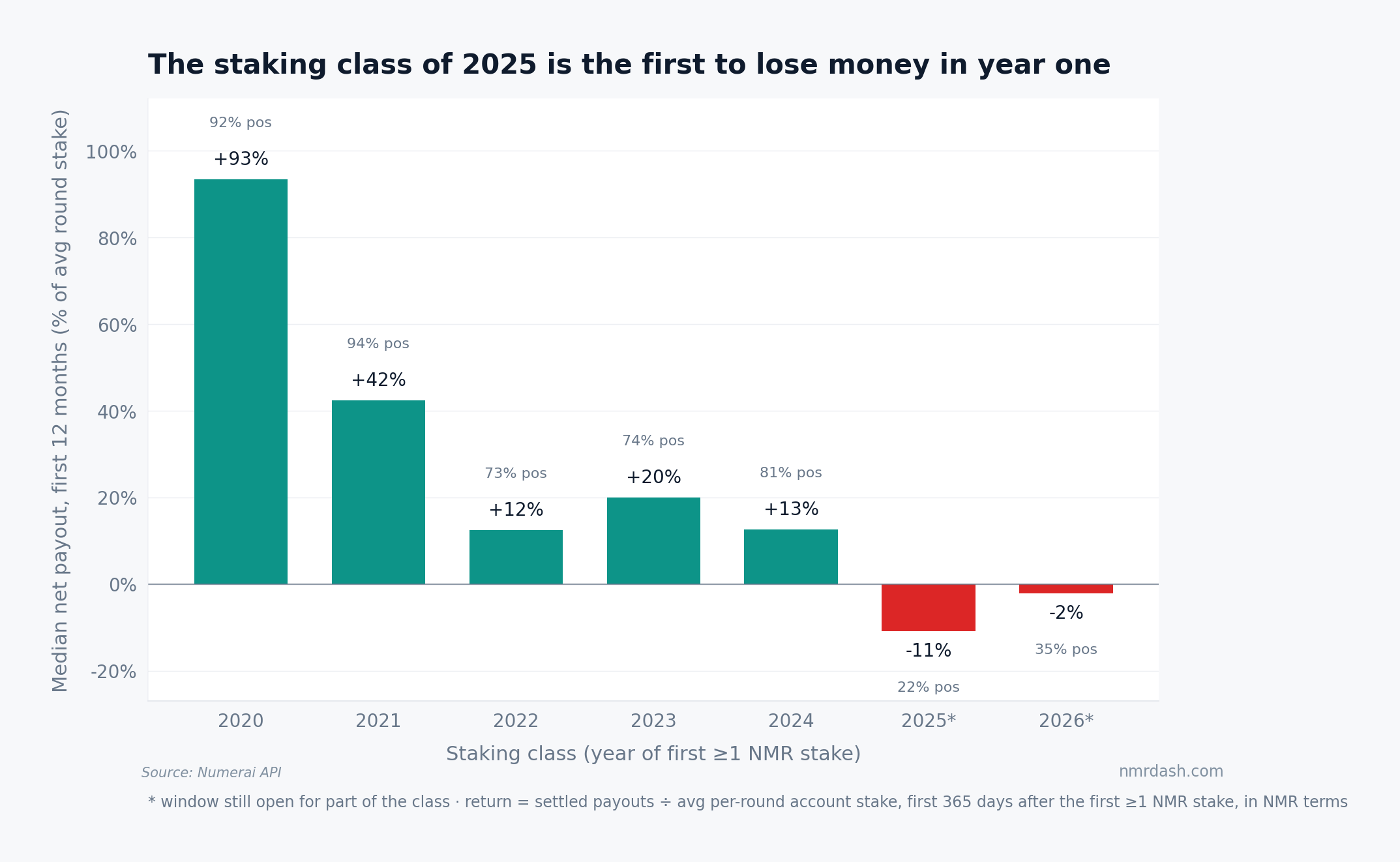
The class of 2020 nearly doubled its NMR in year one (+93% median, 92% of accounts positive) and 2021 compounded at +42%. Then the payout factor did its work: 2022–2024 classes landed between +12% and +20%, still with roughly three-quarters of accounts positive. The class of 2025 broke the streak: a median -11% first year, with only 22% of accounts finishing positive, because their debut coincided with the 2025 burn regime. The 2026 class sits at -2% with its window still open.
These are NMR-denominated tournament returns, not USD outcomes, and the spread says more about eras than about talent: payout rules, payout factors, and market regime dominate any skill difference between generations. It also resolves an apparent paradox with model age analysis: young models score best, but young accounts earned least, because what you earn in year one is mostly set by when you arrive.
What it means
The tournament’s capital base is aging. Accounts that first showed up in 2019–2020 still hold 56% of today’s ~738,000 staked NMR; arrivals from the last 18 months hold about 5%. Meanwhile the conversion funnel that once replenished stakers (try it, score well, stake) has narrowed at every stage: fewer accounts convert, the ones that don’t convert early never do, and results no longer tip the decision. The staked pool is a few hundred people deep: 835 accounts ever reached 100 NMR, and about 270 of them are still staking.
For a newcomer the practical read is friendlier than the funnel looks. The trial is free, a real decision point arrives within your first quarter, and nobody skips the small-stakes phase: the biggest stakers in the tournament started at a median of 15 NMR. The class of 2025’s losses are timing risk, not a verdict on newcomers’ models. If the meta-model is going to keep getting harder to beat, it will be because some of this year’s 90%-no-stake cohort eventually crosses 1 NMR.
Method notes: Classic tournament only; benchmark model rows excluded. Accounts group models by account_name, so the ~5% of historical models whose profiles were deleted are unattributable and excluded. Stake records begin in 2020, so cohort charts omit 2019 arrivals. All returns are in NMR terms.