· 9 min read
Why No-Stake Submissions Outnumber Staked Ones on Numerai
Updated
Historical scope reviewed September 8, 2026. The figures retain the original historical submission sample. Current participation uses completed windows, observed model-list coverage and any positive stake. A missing or not-yet-indexed atomic position is not evidence that a submitter chose to remain unstaked. See the current metric definitions.
Two years ago, every round of the Numerai Classic tournament was a roughly even split: half the submissions had stake on them, half did not. That balance has broken. By April 2026, 65% of submissions in tournament 8 carry no stake — the highest ratio in the data, and the end of an 18-month rise that began in mid-2024.
The shift matters because submission counts are the easiest participation number to quote, and they have decoupled from skin-in-the-game participation. The tournament has 13,012 unique models submitting in the last 30 days, but only 4,687 of them — 36% — have any stake attached. Total stake stands at about 770,000 NMR spread across roughly 4,800 active staked models. Everything else is unsecured prediction traffic.
This post walks through where that traffic is coming from, who is producing it, and what it does and does not tell you about the health of the tournament.
The Trend
The simplest cut is per-round share: of every submission scored in a given month, what fraction had selected_stake_value = 0?
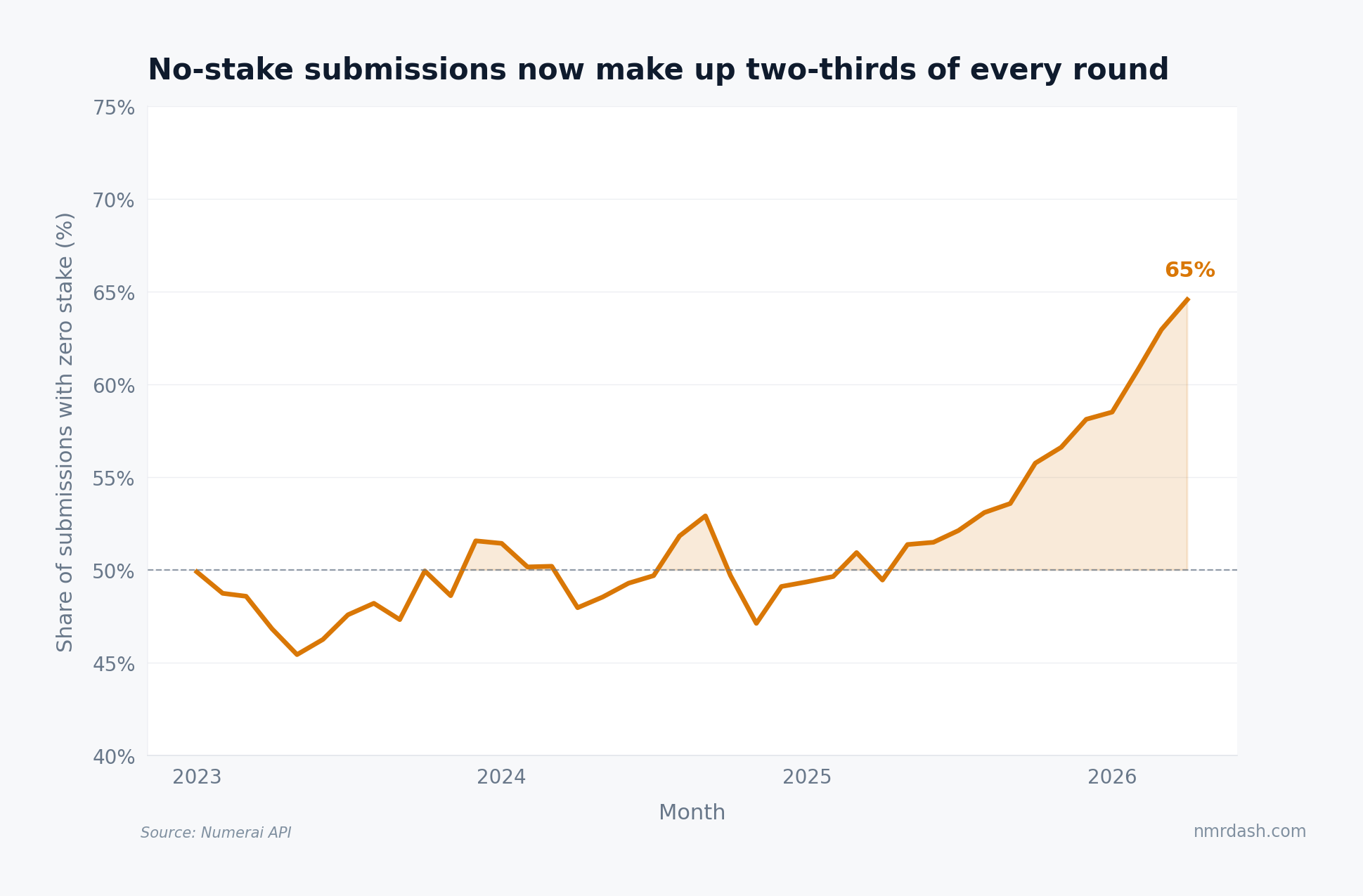
From January 2023 through mid-2025 the share fluctuated between 45% and 53% — noisy but trendless. The line crossed 50% durably in July 2025 and has not been below it since. Each of the last seven months set a new high. April 2026’s 65% is more than 16 percentage points above the mid-2024 baseline.
Round cadence does not explain it. Numerai opens about 22 rounds per month — roughly 17 daily and 5 weekly — and that count has been stable. The denominator did not change; the numerator did.
Where the Surge Comes From
Splitting active models into three buckets makes the source obvious. For each month I tag every distinct model as either:
- Staked — the model put NMR on at least one round that month.
- Stakers’ shadow experiments — the model submitted with no stake, but the same account also runs at least one staked model. These are research forks: candidate models being evaluated alongside the live ones.
- Pure no-stake accounts — the model submitted with no stake, and the account it belongs to has zero staked models.
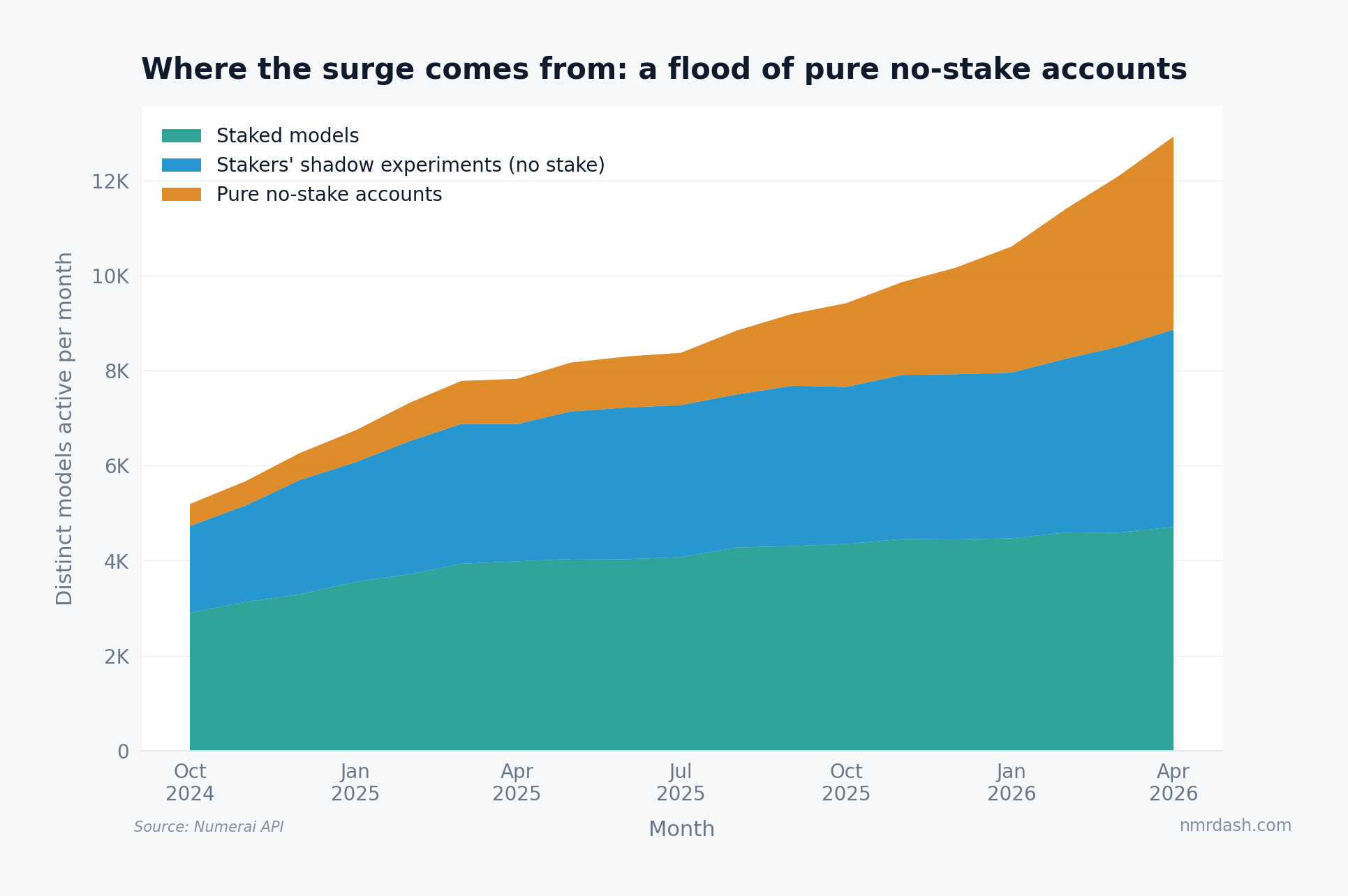
The staked band is almost flat: 3,000 models in October 2024, 4,700 today. Modest, organic growth. The shadow-experiment band roughly doubles. The pure no-stake band is the one doing the work — it grows from about 500 models to over 4,200, an eight-fold increase in 18 months. Today the three bands sit at roughly 4.7K / 4.2K / 4.2K. A year ago the stack was top-heavy with stakers; now it is bottom-heavy with newcomers.
That said, the experimenter cohort is concentrated in a small group: only 315 accounts run shadow experiments, but they average 13.3 unstaked models each, and one account runs 196 of them. These are R&D pipelines spitting out candidates with auto-generated names like 0250222_1109 — date-stamped experiment IDs that submit on every daily round.
A Sample of the Surge
Twenty examples drawn from the last 30 days of submissions, split evenly between the two no-stake cohorts. Every model below has zero stake on it; account names link to the live Numerai account page (numer.ai/~account) and model names to the model page (numer.ai/model).
| Cohort | Account | Sample model | Models on account | First seen |
|---|---|---|---|---|
| Pure no-stake | flitz | flitz | 1 (0 staked) | 2026-05-04 |
| Pure no-stake | vanlbirch | vanlbirch | 1 (0 staked) | 2026-05-06 |
| Pure no-stake | jmencer | jmencer | 1 (0 staked) | 2026-05-04 |
| Pure no-stake | omaru12345 | omaru12345 | 1 (0 staked) | 2026-05-04 |
| Pure no-stake | entangled_99 | entangled_99 | 1 (0 staked) | 2026-05-03 |
| Pure no-stake | shirakamo | shirakamo_fn | 2 (0 staked) | 2026-05-04 |
| Pure no-stake | blueschel | agenticnumerai2 | 3 (0 staked) | 2026-05-04 |
| Pure no-stake | hoangvictor | champ_a_lr003_n_dext | 9 (0 staked) | 2026-05-04 |
| Pure no-stake | mohit21542 | mohit_v10_benchmark | 11 (0 staked) | 2026-05-04 |
| Pure no-stake | alloy2026 | alloy52_ppc_2d2026f | 14 (0 staked) | 2026-05-03 |
| Experimenter | ngmi | ngmi_63 | 63 (1 staked) | 2026-05-04 |
| Experimenter | brainx | hirnx_34_0bmpw1f3 | 61 (28 staked) | 2025-10-20 |
| Experimenter | rustydata | rd42_20251023 | 75 (28 staked) | 2025-10-23 |
| Experimenter | holden263 | hldn_99 | 100 (2 staked) | 2025-11-03 |
| Experimenter | robprofit | robprofit5_2_p5_3306 | 106 (10 staked) | 2026-01-02 |
| Experimenter | nmrdragon | model_17_xgb_fast | 114 (1 staked) | 2025-11-17 |
| Experimenter | yesterday | falcon03 | 125 (1 staked) | 2026-03-28 |
| Experimenter | uuazed | uuazed125 | 125 (11 staked) | 2026-04-07 |
| Experimenter | pschyska | batch_please_110 | 150 (4 staked) | 2025-01-12 |
| Experimenter | neliz | ng_95 | 200 (1 staked) | 2025-08-08 |
The pure-no-stake half skews toward fresh accounts with one to a handful of models, often with telltale _te or _test suffixes on the model names. The experimenter half is the opposite: long-running accounts with dozens to hundreds of models, only a small fraction of which carry any NMR. neliz runs 200 models with one staked; nmrdragon runs 114 with one staked; pschyska runs 150 with four. These are stake-budget allocation strategies dressed up as model rosters — the staked ones are the chosen few, the rest are the pipeline.
New Cohorts Skip the Staking Step
The cleanest evidence that this is a behavioral change, not a statistical artifact, comes from looking at fresh model cohorts. For every model, find the month it first submitted, then ask: did this model ever put stake on, at any point in its life?
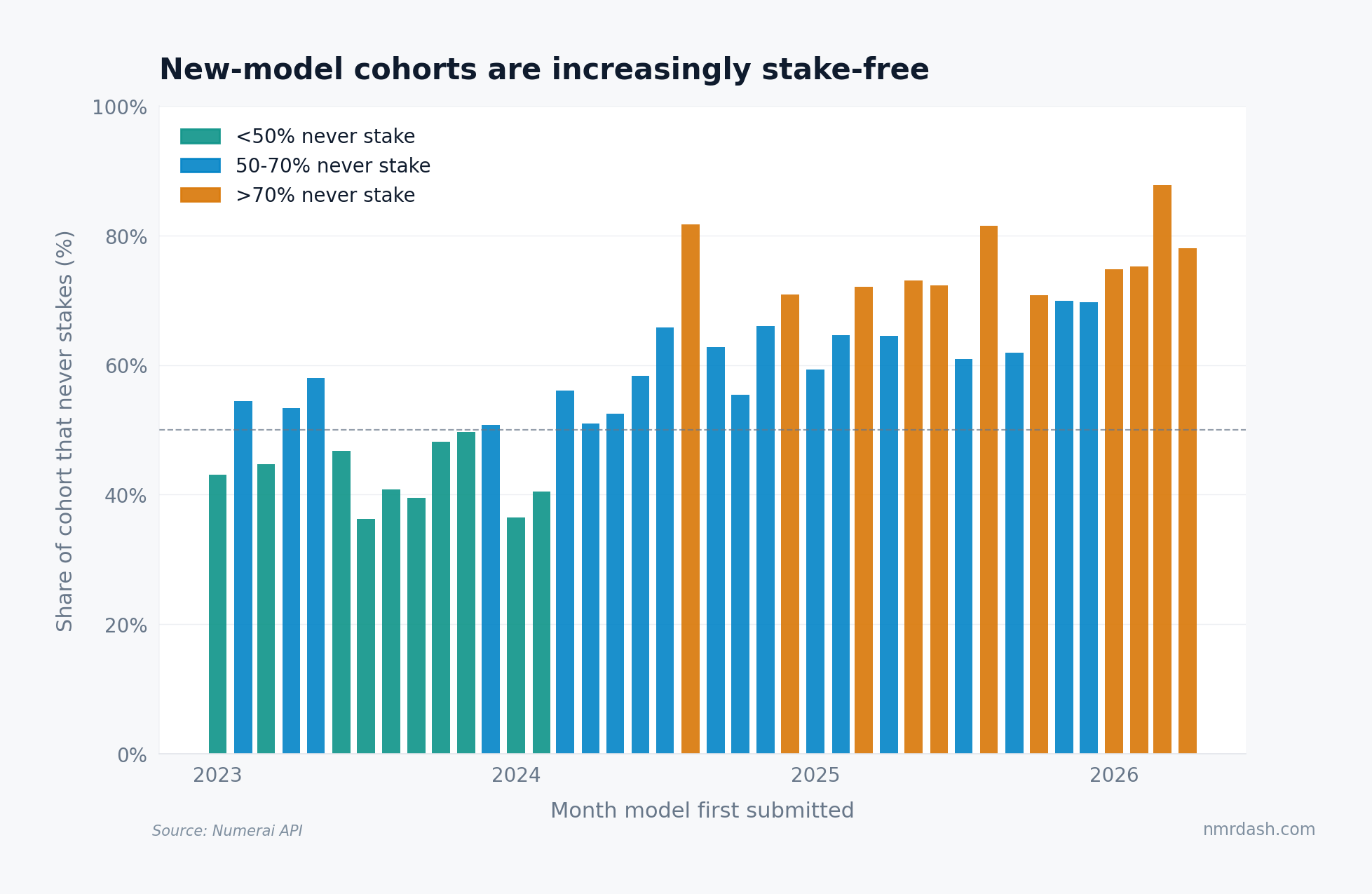
In 2023 a new model had a coin-flip chance of putting stake on within its lifetime. The rate started rising in late 2024 and has not slowed: of the 1,203 models that first appeared in March 2026, 87.8% have still never staked. The April 2026 cohort sits at 78.1%.
This is not models churning out of stake. It is models that arrive without stake and stay that way. The default behavior for a new account has flipped from “stake to play” to “submit first, decide later (or never).”
The Quality Gap is Smaller Than You’d Expect
If the surge were spam — random predictions or dummy submissions — the score gap between staked and no-stake submissions would be cavernous. It is not.

Staked submissions out-score no-stake ones in almost every quarter, but the gap is narrow — typically 0.002 to 0.005 of mean CORJ60 in earlier quarters, widening to 0.006-0.008 in 2025-Q4 and 2026-Q1. Both cohorts move together with market regime. When 2025-Q4 went negative for everyone, no-stake went a little more negative. There is no period where no-stake submissions look like noise. Many of these models are real attempts at modeling the targets; the people running them just are not putting NMR on the line.
What’s Actually Driving It
The data does not directly identify the cause, but four plausible structural shifts are consistent with what you see:
- The daily round shifted the staking commitment. Daily rounds were rolled out before this trend started, but the cumulative effect of seeing 17 daily rounds plus 5 weekly rounds per month is a constant invitation to submit, while staking still locks NMR for several rounds. Submitting is cheap; staking is not.
- Tooling makes submission near-free. Numerai Compute, community examples, and forks of the official benchmark notebook have made the submission loop a few-minute job. Once a pipeline exists, running a candidate model in shadow mode costs nothing extra.
- NMR’s price environment matters. Through most of this surge, NMR has traded well below its prior highs. Holding NMR to stake it is a capital allocation decision, not just a participation choice, and many participants would rather submit while waiting on an entry point.
- Newcomers default differently. A user landing on Numerai today reads documentation that emphasizes you can submit without staking, and meets a community where shadow experiments are normal. The 2023 norm of “stake on day one” appears to have faded.
What It Means for Tournament Metrics
The practical consequence is that submission-count headlines now lag the meaningful signal by a wide margin. Staked model count is the metric that matters. It is the input to the meta-model, the source of payout flows, and the number that moves NMR. A round with 15,000 submissions and 4,500 stakers tells you the same thing as a round with 9,000 submissions and 4,500 stakers — the meta-model is identical.
There is also a latent supply story embedded in the bottom band of the cohort chart: roughly 1,300 distinct accounts (running over 4,000 models between them) are already plugged into the submission pipeline with zero stake. If even 10% of those accounts converted to staking — at typical stake sizes — total at-stake NMR would jump meaningfully. The conversion rate is the lever; the audience is already there.
The current model participation chart separates submitters with and without any positive stake. It provides context for this historical surge, but its eligibility rule and observation window differ from this study’s cohorts.