· 5 min read
NMR Price vs Tournament Activity: Six Years of Correlation
Updated
Historical scope reviewed September 8, 2026. Price and participation are historical associations. Raw round stake cannot be carried through atomic migration as measured capital. NMR quantity, USD valuation and unique account counts require separate series; shared trends do not establish price causation. See the current metric definitions.
In the April 28, 2026 snapshot, Numerai NMR staking totaled 830,184 NMR, 2.5x the amount staked when the token hit its $89.45 all-time high in April 2021. Despite that, the token sat near $9, roughly one-tenth of its peak. That weakens a simple “more stake means higher price” thesis. The full Pearson correlation between NMR price and total stake from 2019 to 2026 is -0.44.
This post tests whether NMR is a tournament-driven asset or just another small-cap crypto that follows the broader market. The dataset joins 3,209 daily NMR prices to 2,341 days of total-stake history and 1,073 days of staked-model counts. Current stake and model participation charts show their own observation dates; the price comparisons below retain this study’s sample.
The Long View
NMR price and tournament participation moved in opposite directions over the dataset. NMR closed at $27 on its first observed day (2017-07-13), bottomed at $2.06 on 2018-11-27, peaked at $89.45 on 2021-04-18, and sat at $8.91 in the April 28, 2026 snapshot. Total stake went the other way: from a token-launch value near zero in late 2019 to a 1,098K NMR peak in March 2023, to 830K NMR in April 2026. Stake quadrupled while price collapsed.

The two series briefly aligned around the 2021 bull run, then diverged. Stake kept compounding through the 2022 crypto winter and the 2024-2025 model-count expansion. Price tracked broader crypto beta, falling 80%-plus from the peak before stabilising in single digits. Rising tournament participation has not been sufficient to lift the token. Some stake growth may come from earned NMR being recycled rather than fresh open-market buying.
Same Price, Different Tournament
The scatter of price against staked-model count makes the regime split obvious. Each dot is a single day; the color encodes the year.
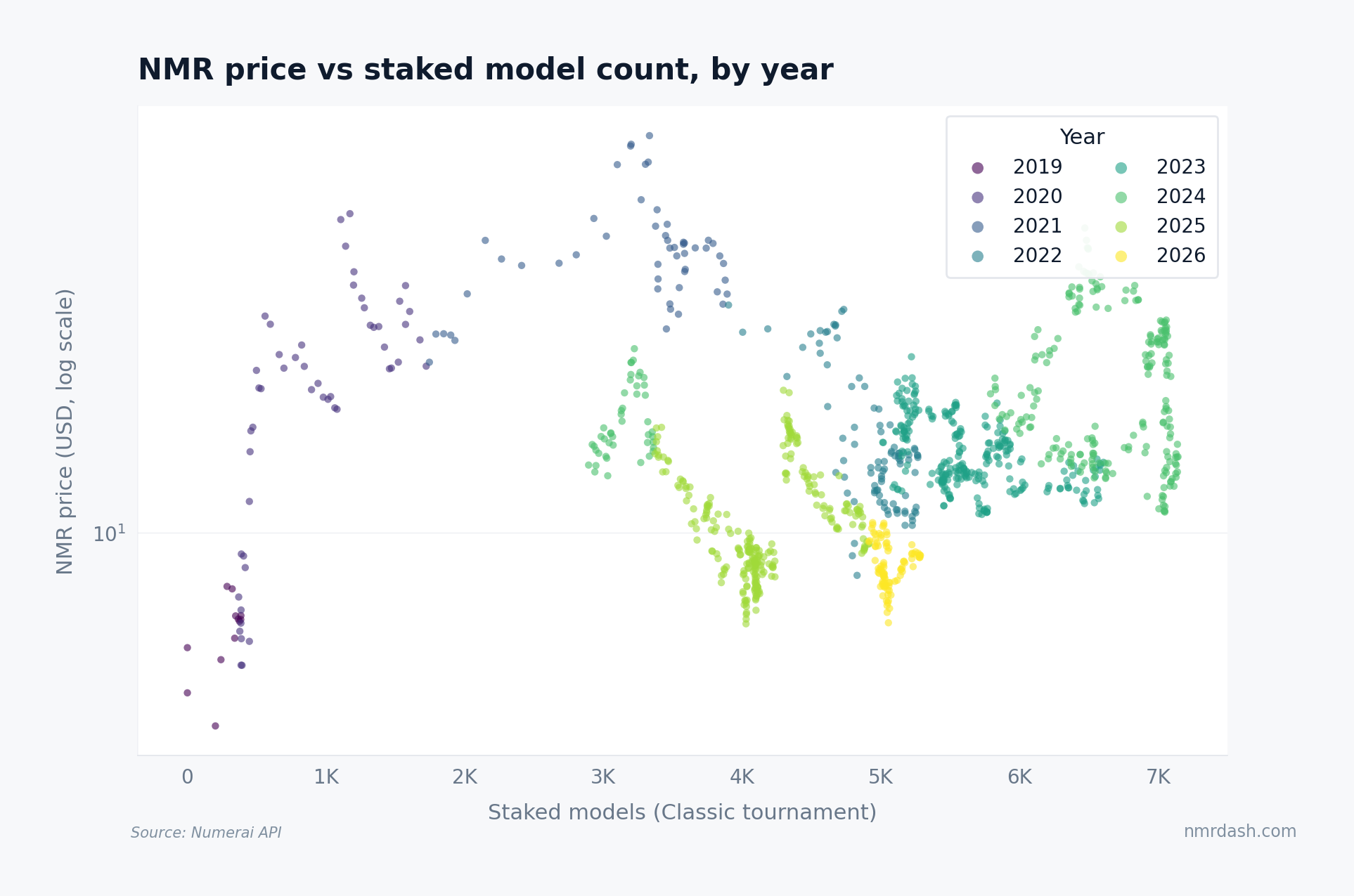
The 2021 cluster sits in the top-left corner: prices in the $30-$90 band with only 3,000-3,300 staked models. By 2024, model count more than doubled (peak 7,144 on 2024-07-16) but the price band moved down to roughly $10-$25. The 2026 cluster (yellow) sits near the bottom of the chart at 5,000-5,300 models and prices under $10.
Read horizontally, the same model count produced wildly different prices across years. Read vertically, the same price produced wildly different participation. There is no clean line through the cloud. The pattern is more consistent with broader crypto sentiment dominating the relationship, and the tournament does not control it.
The Rolling Correlation Flips Every Few Quarters
A static Pearson r of -0.44 hides huge swings. The 90-day rolling correlation between price and stake ranges from +0.95 (2021-04-20, mid-bull-run) to -0.95 (2022-06-28, deep bear market). That is a near-180-degree flip in 14 months.
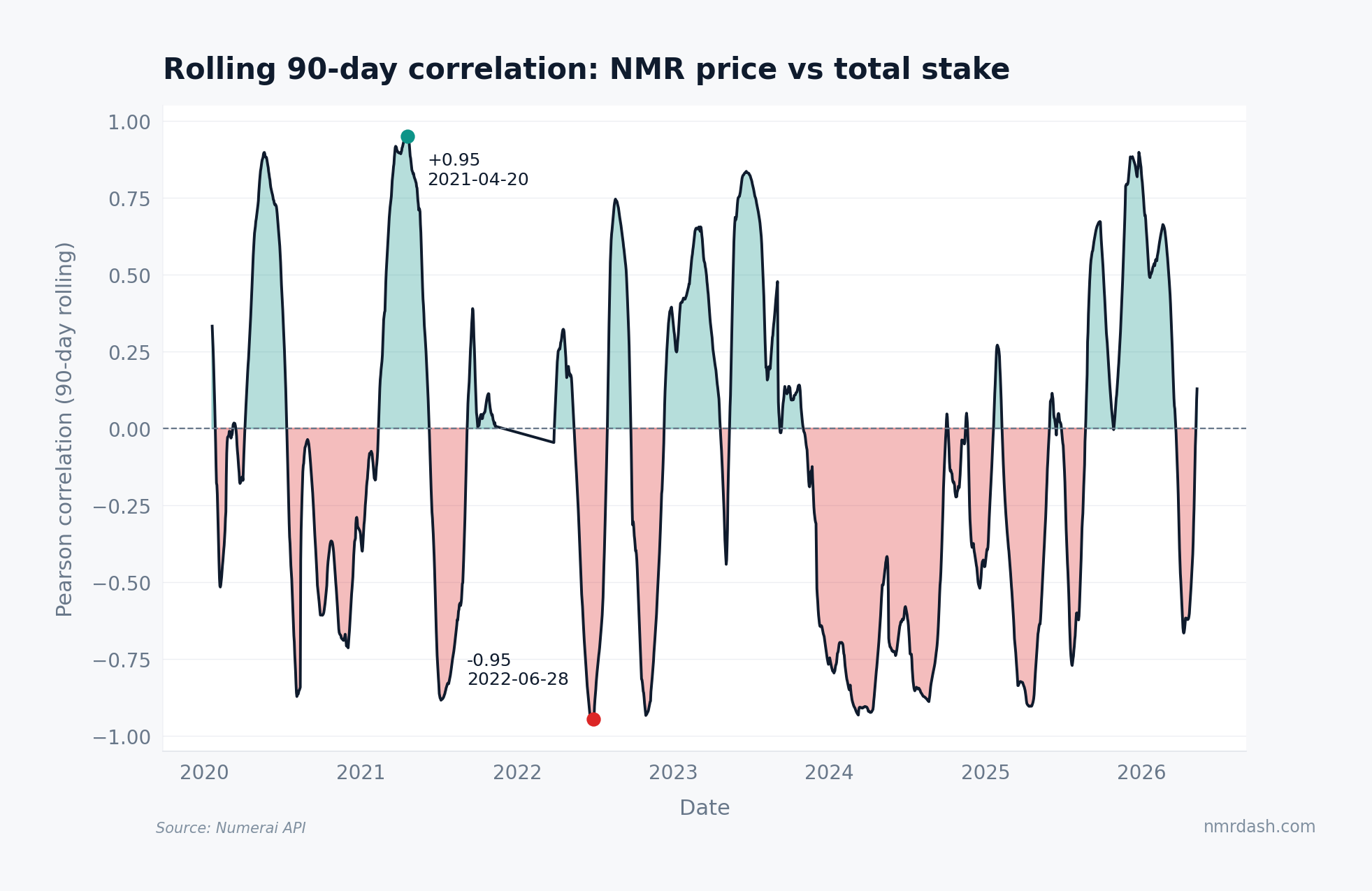
The 90-day correlation spent more time below zero than above (median -0.13, mean -0.12 across 2,249 windows). Long stretches of 2022, 2024, and 2025 ran in the -0.5 to -0.9 band: stake grew while price fell. Brief positive windows in 2021, late 2022, and parts of 2023 lined up with price rallies that happened during stake growth, then reverted within a quarter or two. Modelling NMR off staking data alone gives an unstable forecast.
Tournament Stake Now Equals 12% Of Market Cap
The cleanest framing of structural NMR demand is staked-NMR-in-USD as a fraction of total NMR market cap. At the 2021 ATH, $29.6M of stake represented just 5.9% of NMR’s $504M market cap. In the April 2026 snapshot, $7.4M of stake represented 11.8% of a $63M market cap. The peak ratio of 17.7% hit in March 2023, when total stake briefly crossed 1.09M NMR while the token traded near $19.
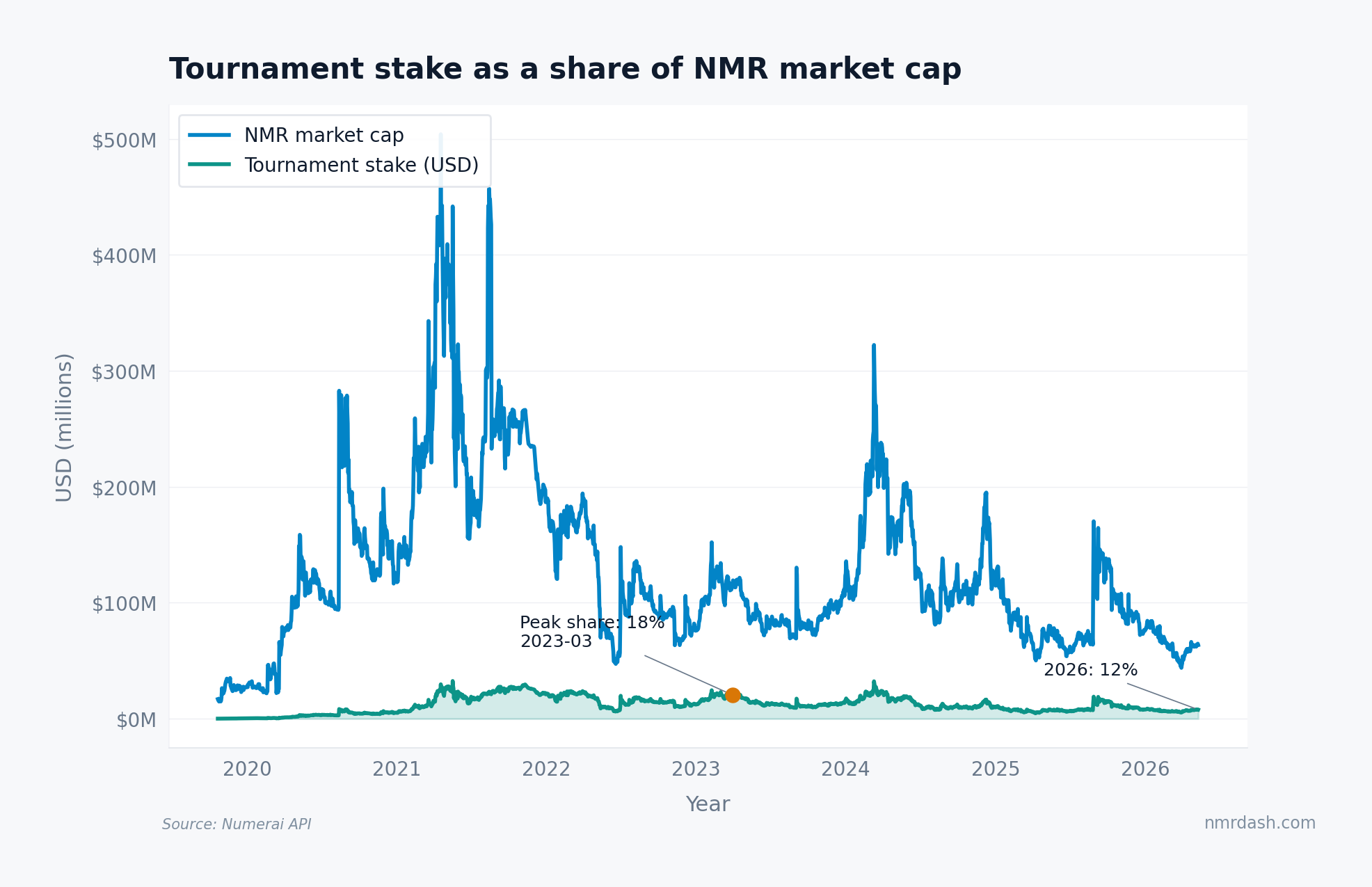
A higher ratio means tournament risk capital represents a larger slice of the float. The chart also shows that even peak tournament stake remained too small to explain most market value. The bulk of NMR value gets set on exchanges, where the marginal trader is a generalist crypto investor — not a Numerai data scientist with thousands of active models backing predictions.
The mechanics back the math. Tournament stake locks NMR for a four-week resolution cycle, then frees it for re-staking or sale — so even 12% of market cap is not “locked” supply in the way protocol staking is on a chain like Ethereum. The float available to short-term traders never drops below ~88% of supply, which is why exchange flows dominate price discovery.
What This Means For Stakers
NMR is not a tournament-driven asset by the numbers. The full-period correlation is negative, the rolling correlation flips signs every few quarters, and the price ATH happened with about one-third of the April 2026 staked NMR. Read is staking profitable and break-even analysis for the participant-level math. This post only argues that more stakers does not mean a higher token.
Tournament earnings get paid in NMR, but the USD value of those earnings rides crypto beta. A burn round on a falling NMR price compounds the loss. Payouts during a crypto bull market can outrun the model performance that earned them. Sizing a stake against a USD risk budget, not a fixed NMR amount, helps control that beta. Through April 2026, the data says the token trades on its own clock. Watch the stake flows chart for the first sign that changes.