· 6 min read
Numerai 2026: A Statistical Snapshot Of The Tournament
Updated
Historical scope reviewed September 8, 2026. This is the original historical tournament snapshot, not current September 2026 conditions. Classic figures are not all-tournament totals. Atomic migration changes the capital denominator; historical chart levels and dates are retained rather than relabeled as current. See the current metric definitions.
In April 2026, Numerai’s registered adviser reported $1.045B in regulatory AUM — but the entire token market cap behind the tournament that supplies its signals was just $62.7M. The fund is 17× the size of the asset its model contributors stake. Sitting between those two numbers: 830,184 NMR locked across 6,467 active models, the average payout factor down to 0.112 from 0.143 a year ago, and a tournament that has rebuilt to 82% of its late-2024 staker count after a 63% one-week cleanup. That is the shape of the 2026 snapshot — billion-dollar fund, sub-$100M token, and a steadily compressing yield.
This article pulls the numbers that matter for a year-in-numbers view, sourced directly from the Numerai API and SEC filings. The nmrdash dashboard follows supported tournament and holdings series with separate observation dates; the figures here remain a point-in-time snapshot.
How Much NMR Is At Stake In 2026
Total NMR at stake is 830,184 NMR, up from 785,475 NMR a year ago. That is a 5.7% increase over twelve months and a 1.0% increase since January 1, 2026.
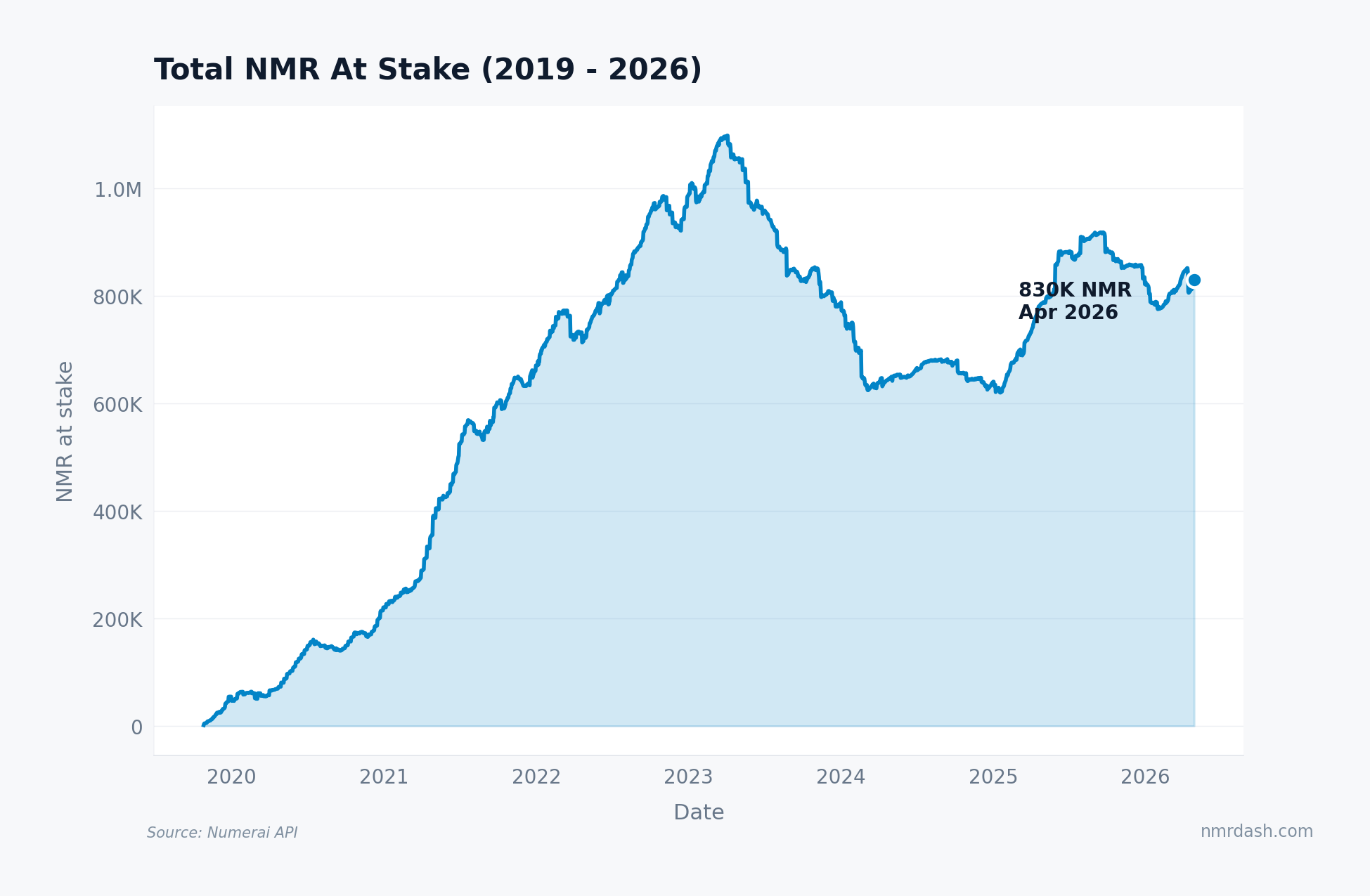
The all-time peak was 1.10M NMR on April 5, 2023, after which stake drifted lower through the 2023-2024 bear market. The recovery from the 2025 trough near 620K NMR has added more than 200K NMR back into the bond pool. At the April 28 NMR price, the staked supply is worth roughly $7.4M, locked behind round resolution as the cost of fielding a model in the Classic tournament.
Stake is the bond, not the prize. Stakers risk it on every round, so the size of the pool is the cleanest single signal of conviction in the tournament’s economics. The round economics note explains the outcome accounting; stake history shows the observed tournament totals.
Active Staked Models By Tournament
The 6,467 active staked models split 5,271 Classic, 642 Signals, and 554 Crypto.
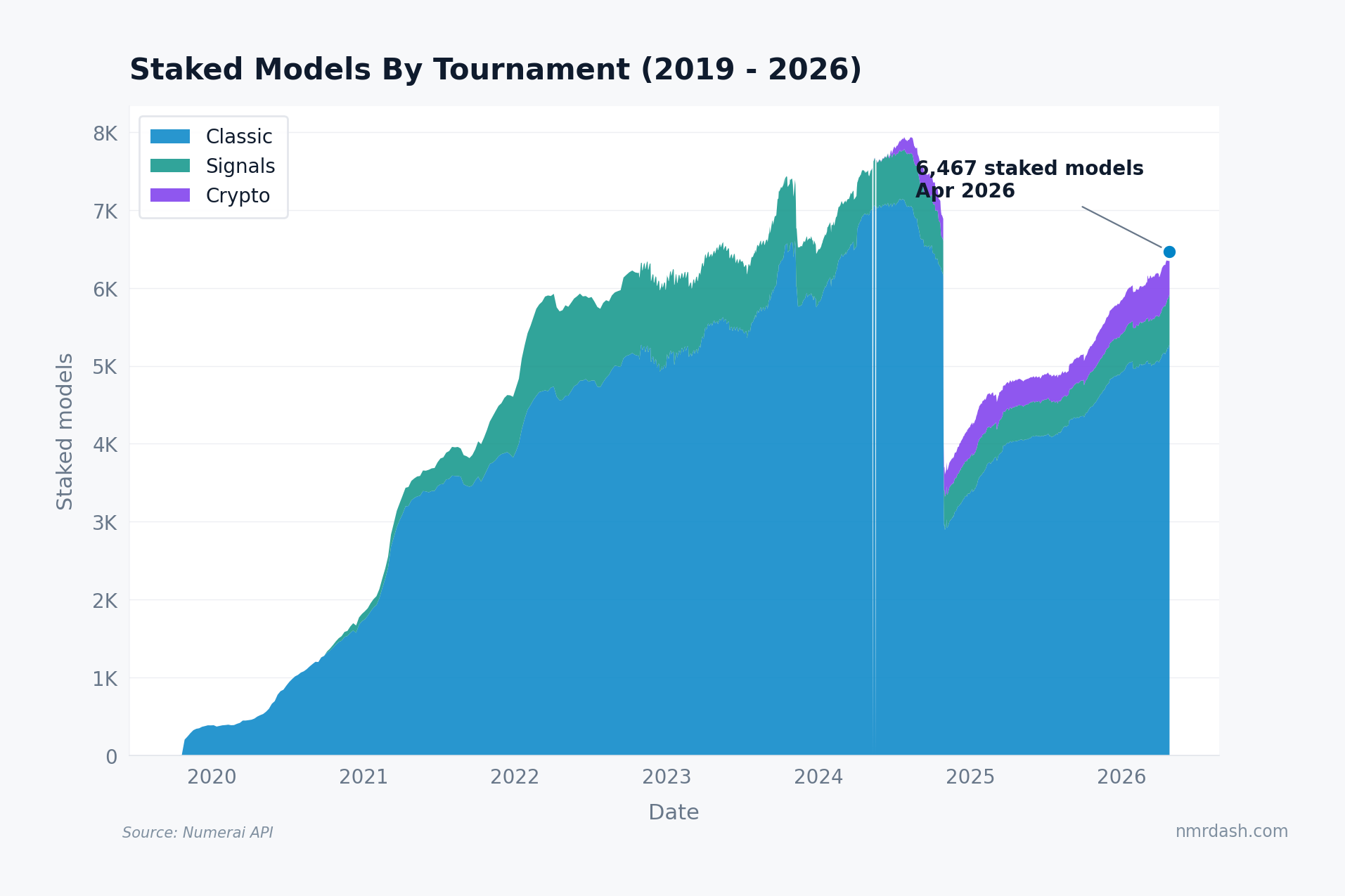
The cliff in late 2024 is real, not a data glitch. Numerai retired thousands of inactive Classic accounts when the new staking framework rolled out, dropping the field from 7,900 models to about 2,900 in a single week. Eighteen months later the active count has rebuilt to 6,467, with Crypto growing from a 200-model curiosity to a 554-model tournament and Signals stabilizing around 640.
Classic still dominates at 81% of all staked models. Signals (10%) and Crypto (9%) are smaller but more concentrated. Average stake per model is 157 NMR for Signals and 99 NMR for Crypto versus 82 NMR for Classic. The cross-tournament comparison article walks through how the three tournaments differ in payout dynamics.
NMR Price And Market Cap In 2026
NMR was priced at $8.91 in the April 28 snapshot, with a $62.7M market cap, down from $9.09 a year earlier and well below the $89 all-time high from 2021.
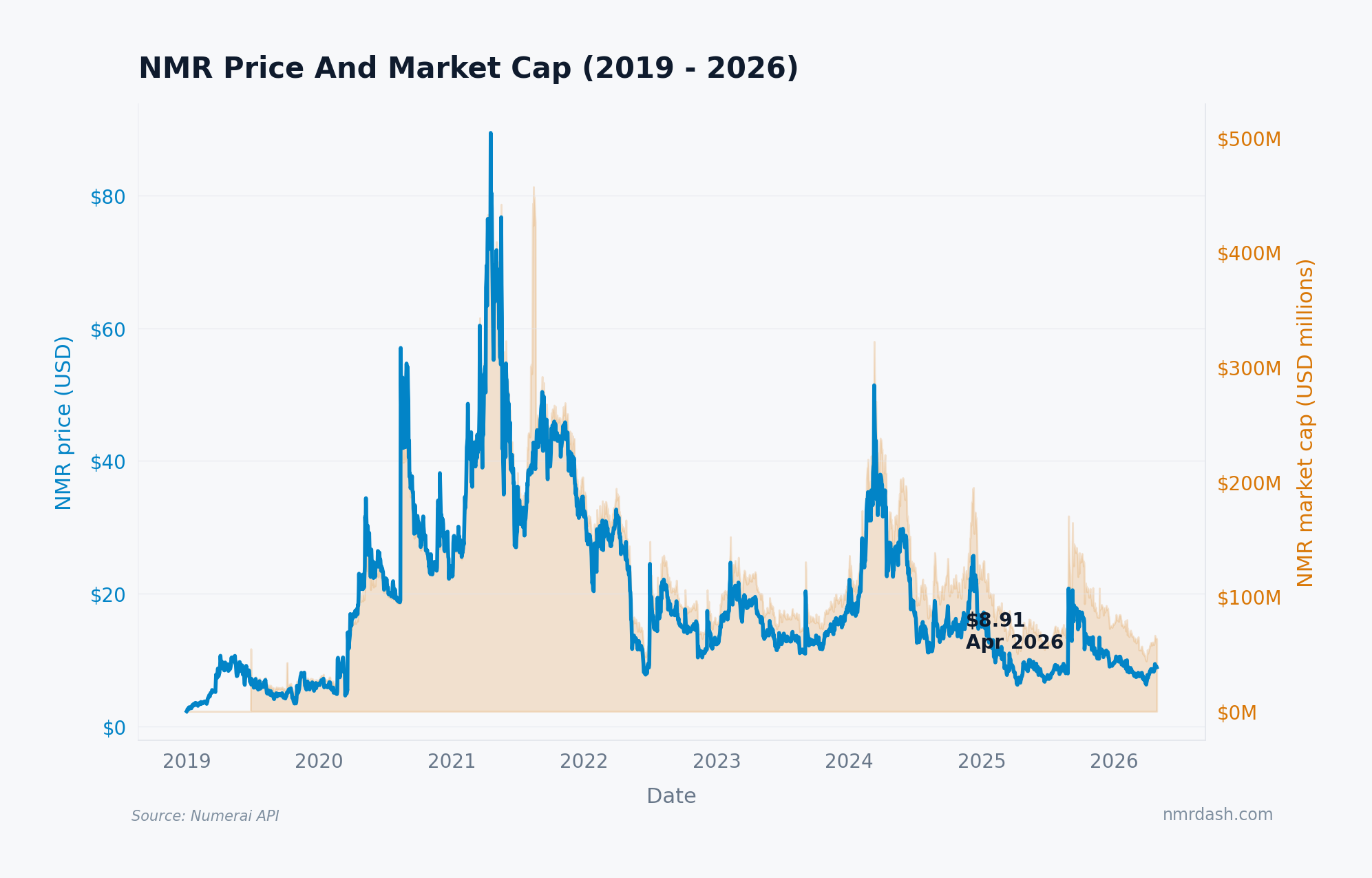
The price has compressed alongside the broader crypto-equity correlation: from the 2021 peak above $80, NMR spent most of 2024 through April 2026 in a $7-$25 band. Market cap tracked price to a $60-200M range, with the April 28 snapshot near the floor at $62.7M. With 830,184 NMR staked, the bonded supply represented 11.8% of the circulating market cap — a high enough share to make the tournament a meaningful sink for the token.
The other side of the ledger is adviser scale. Numerai’s April 1, 2026 Form ADV, discussed in the quarterly AUM study, reported $1.045B in regulatory AUM, which makes the regulatory-AUM-to-stake ratio roughly 141:1 in dollar terms. The hedge fund is paying in NMR for signals used in a much larger dollar portfolio, but AUM, token market cap, and staked collateral are different measures.
Recent Payouts And Burns
Over the last 24 months in Classic, monthly net payouts have ranged from -5,343 NMR (December 2025) to +25,302 NMR (February 2025), with January-March 2026 averaging +19,332 NMR per month.
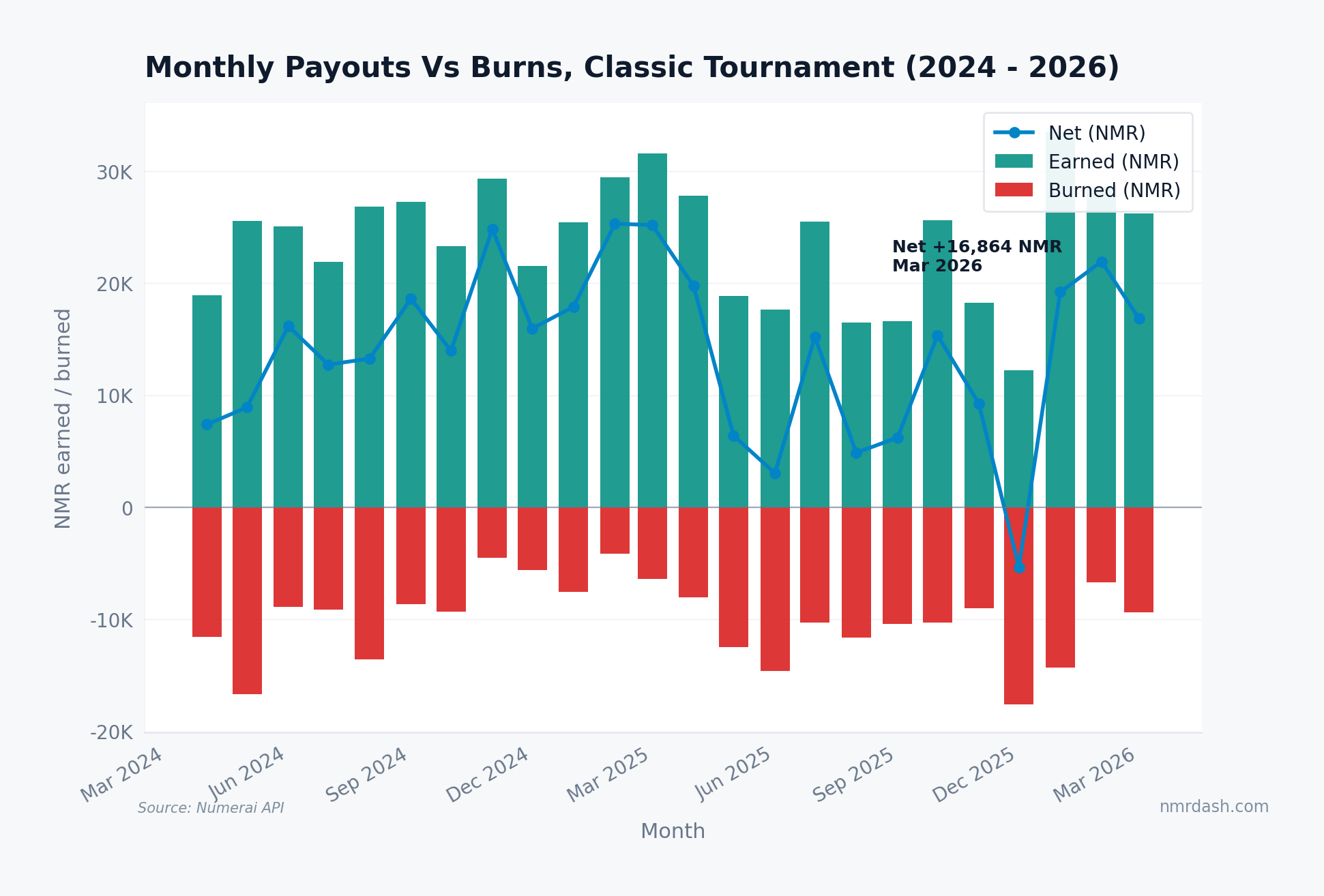
Net flow has been positive in 23 of the last 24 months. Earned averaged 23,500 NMR per month and burned averaged 9,800 NMR, leaving 13,700 NMR per month net. That adds up to roughly 329,000 NMR distributed to Classic stakers over the two-year window. The one clearly negative month (December 2025 at -5,343 NMR) lines up with the drawdown the market regimes article covers.
Lifetime totals across all three tournaments: 3.12M NMR earned, 1.28M NMR burned, 1.84M NMR net distributed. Classic alone accounts for 1.39M NMR of net payouts since round 168. The average payout factor in 2026 has been 0.112, down from 0.143 in early 2025 — Numerai’s payout-factor knob has tightened as stake has grown, which is exactly the design behavior the payout factor article describes.
What 2026 Tells Stakers
Three things to take away from the numbers.
The tournament is still net positive-sum, but margins are thinner. Net Classic payouts in 2026 are running at roughly 1,000 NMR per round, or about 0.15% per round on the staked pool. Those are historical round-position ratios, not a reconstructed annual account return. The recorded payout policy also changed: payout factor has fallen 22% year-over-year (0.143 → 0.112) as the pool grew, so the same model with the same score earns proportionally less today. The is staking profitable article shows how that aggregate number masks wide per-model variation.
Model count is no longer the obvious bottleneck. With 6,467 active staked models split across three tournaments, Numerai is back near pre-cleanup capacity. Nominal participation is high, but meta-model crowding and stake concentration matter more than the raw model count.
Adviser scale and token price are different gauges. $1.045B of regulatory AUM alongside a $62.7M token market cap shows how different the fund and token balance sheets are. The SEC institutional footprint article breaks down what that scale looks like inside the 13F filings — including 608 reported holdings and about $830M of reported long-equity value in the December 2025 13F.
This article remains an April 28, 2026 snapshot. The dashboard shows newer observations for its supported charts, each with its own source date; it does not refresh every statistic in this post.