· 5 min read
Meta-Model Crowding: The Tax on Success
Updated
Historical scope reviewed September 8, 2026. Model stake shares and correlations of score histories are separate concentration proxies. Neither counts independent prediction strategies. Account-level concentration needs historical ownership, and payout-score comparisons need matched versions and maturity. See the current metric definitions.
Numerai’s stake-weighted meta-model has a built-in paradox: the better a model performs, the more stake it accumulates; the more stake it holds, the heavier its weight in the meta-model; and the heavier its weight, the more its predictions are the meta-model. At that point, MMC, the metric that rewards originality, trends toward zero. As a model gains stake, part of its signal becomes embedded in the meta-model, reducing the residual originality MMC can reward.
How large is this “crowding tax,” and is it getting worse? The data from over 30,000 recent model-round observations paints a clear picture.
Stake and Meta-Model Correlation
The first question: do larger stakers actually correlate more with the meta-model?
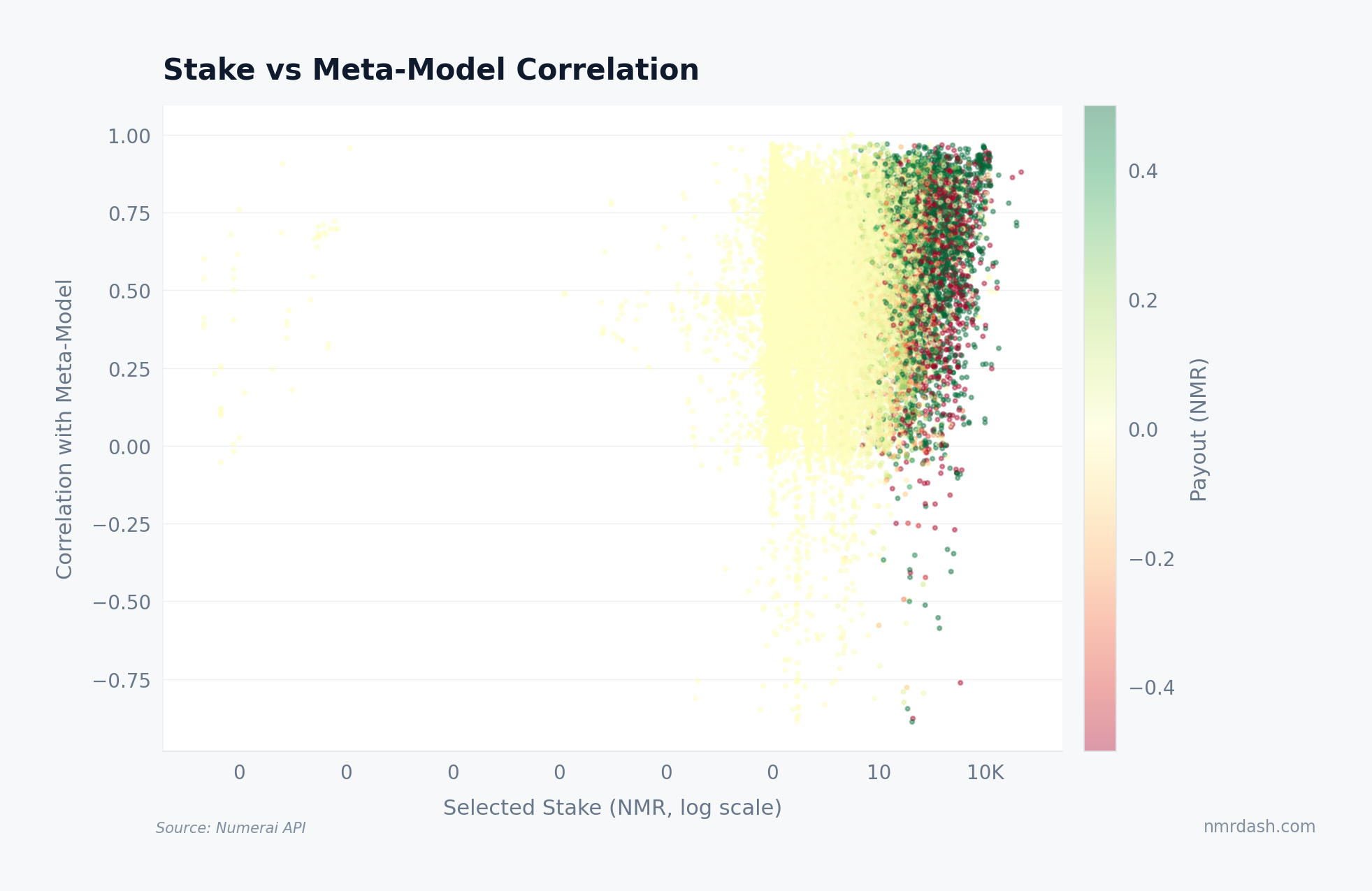
The relationship is visible in the scatter. Models at the high end of the stake axis cluster at corr_w_meta_model values of roughly 0.3–0.95, while small stakers spread across the full range, from deeply negative to nearly 1.0. The typical large staker sits well above the typical small one on this axis.
This is partly mechanical (a model weighted at 5% of the meta-model has 5% of itself baked in) and partly selection: large stakers tend to use similar high-quality features and architectures, producing correlated predictions even before stake weighting enters the picture. The meta-model structure article explores the concentration side; here the focus is on what that correlation costs.
The MMC Penalty by Meta-Model Decile
If high meta-model correlation is the disease, reduced MMC is the symptom. Grouping all observations by their corr_w_meta_model decile reveals a steep gradient.
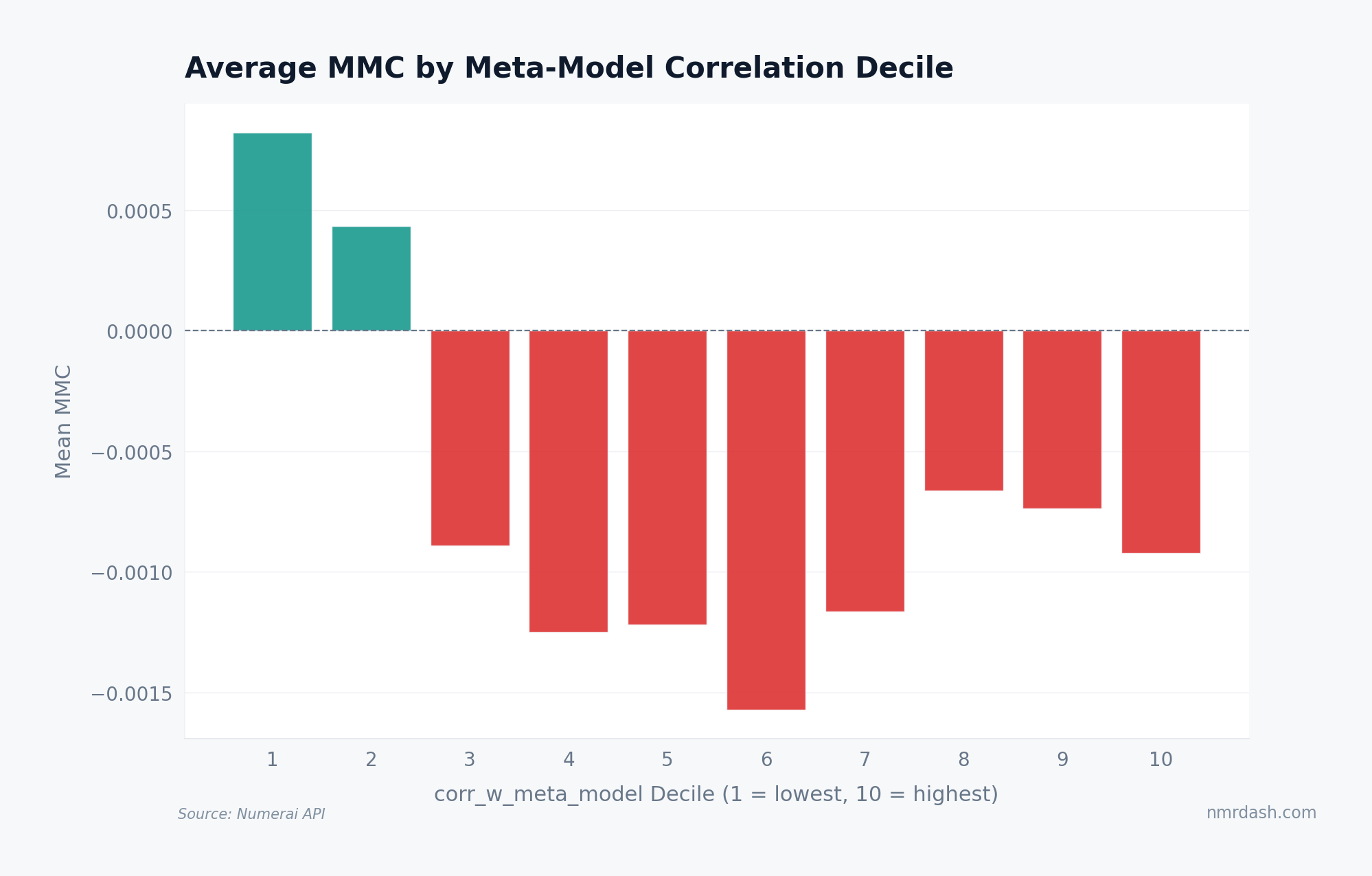
Only the two lowest meta-model-correlation deciles average positive MMC: about +0.0008 for decile 1 and +0.0004 for decile 2, the scores that earn the 2x multiplier in the payout formula. Every decile from 3 upward averages negative, bottoming near -0.0016 at decile 6 and sitting around -0.0009 in decile 10.
The penalty is not reserved for the extreme top end. It arrives as soon as a model’s correlation leaves the bottom fifth of the field: median correlation with the meta-model already means negative expected MMC.
Is Crowding Getting Worse?
Here, the stake-weighted mean corr_w_meta_model per round tells whether the problem is stable or compounding within this historical sample. The dashboard’s model-to-model performance correlation instead measures co-movement in model score histories; it is not prediction correlation with the meta-model.
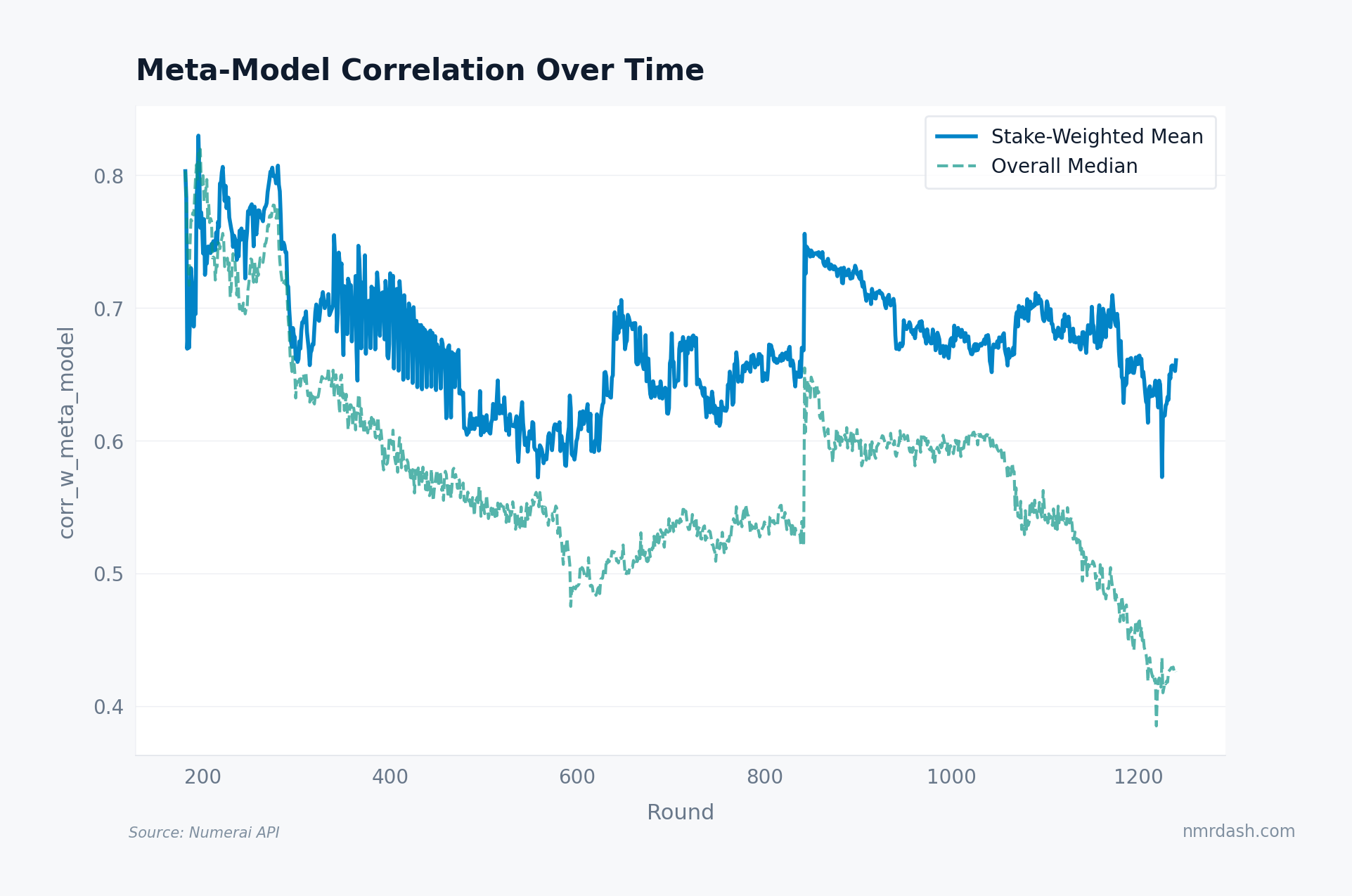
The stake-weighted mean has held stubbornly high, in a 0.6–0.75 band across the tournament’s history, sitting near 0.66 in recent rounds. The unweighted median has fallen away from it, sliding from roughly 0.6 in the mid-history to about 0.43 recently as newer small stakers bring more diverse signals. The gap between the two lines is the widest on record: capital stays locked to the meta-model while the crowd as a whole diversifies.
This is the structural trend that makes the diversification paradox worse over time. As large stakers persist in the historical sample, they collectively drag the meta-model toward their shared strategy space.
The Crowding Tax: MMC After a Stake Increase
The cleanest test isolates models that dramatically increased their stake (those that crossed from small to large) and tracks what happened to their MMC.
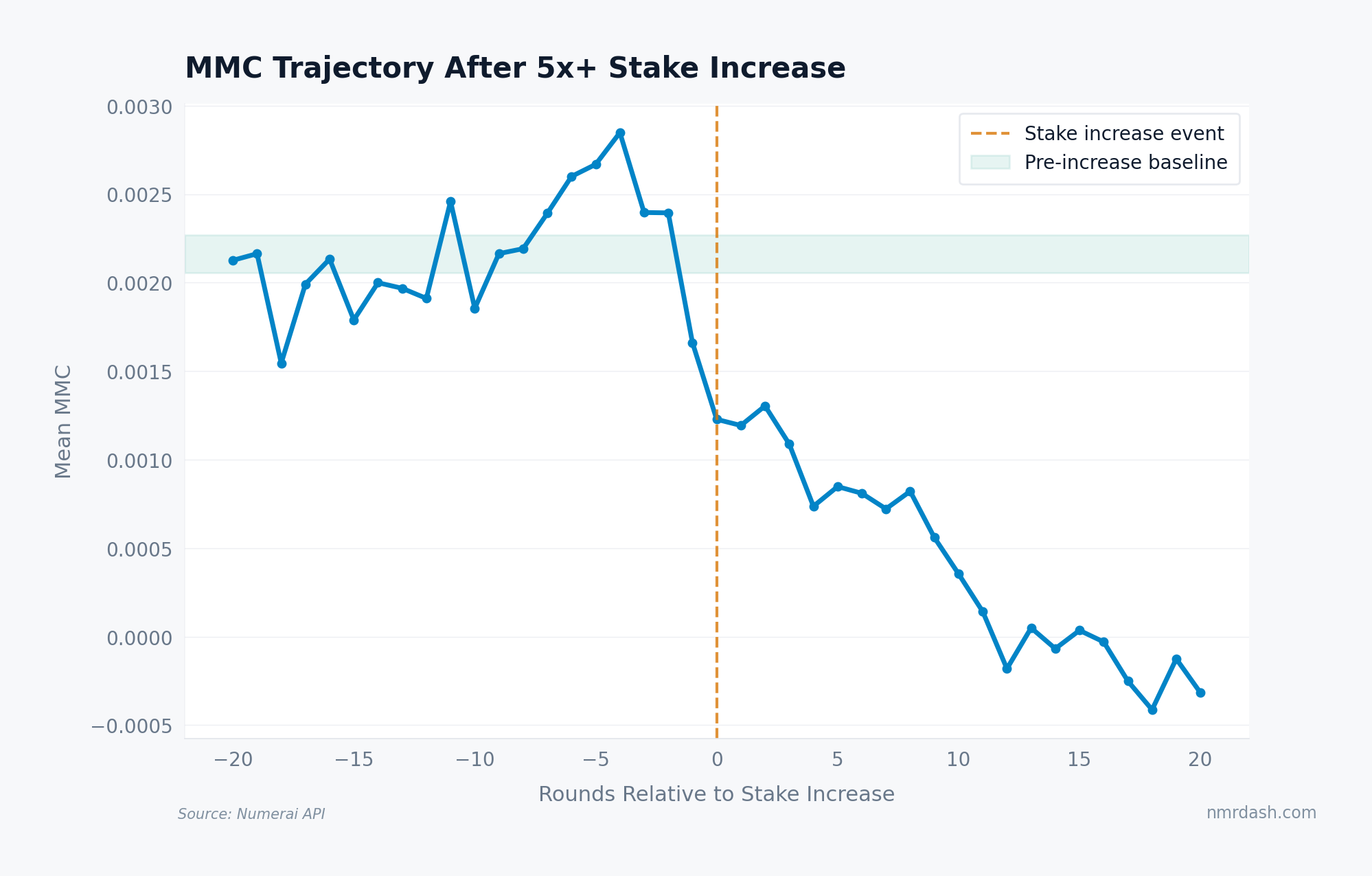
For models that increased stake by 5x or more between adjacent rounds, mean MMC in the 20 rounds before the increase ran near 0.002. It drops to about 0.0012 at the event itself and keeps decaying afterward, crossing zero around 12 rounds out and ending slightly negative by round 20. There is no stabilization at a lower plateau: the decay continues through the whole post-event window.
The stable CORJ60 window argues against simple model degradation, but the chart still shows association rather than a randomized causal effect. More stake means more influence, which means higher correlation with the aggregate, which can mean lower MMC. The crowding tax is measurable, but its size should be read as an observed post-stake-increase pattern rather than a pure causal estimate.
Takeaways
-
Large stakers pay a crowding tax. High-stake models cluster at much higher meta-model correlation than small ones, and only the two least-correlated deciles earn positive average MMC.
-
The gap between capital and crowd keeps widening. Stake-weighted meta-model correlation holds near 0.66 while the unweighted median has slid toward 0.43: the same large models retain their influence in this sample as the crowd diversifies.
-
A 5x stake increase is followed by lower MMC. Average MMC decays from about 0.002 before the event to roughly zero 20 rounds after, with stable CORJ60 making simple model degradation less likely.
-
Diversification is the only sustainable defense. Small stakers are naturally insulated; large stakers must stay uncorrelated with dominant strategies. The diversification paradox explains why that is harder than it sounds.