· 5 min read
Numerai vs Kaggle: Where Data Scientists Actually Earn
Updated
Historical scope reviewed September 8, 2026. Numerai rewards recurring proprietary prediction contribution with NMR at risk. Atomic positions require separately committed capital and have tournament-specific payout rules. Historical tournament yields are not guaranteed competition prizes or an interest in the hedge fund. See the current metric definitions.
Numerai vs Kaggle is a comparison of cashflow shapes more than total dollars. Numerai has paid out 2,444,516 NMR in earnings against 1,054,553 NMR in stake burns since round 168 in July 2019, leaving an aggregate difference of 1,389,964 NMR over the historical sample. That aggregate does not mean every model was profitable. Kaggle, by contrast, gathers a year of work into a single payout when a leaderboard freezes. Both platforms attract quantitative modelers, but they reward different operating styles. Background on the staking mechanic is in How Numerai Works.
This post lines up four Numerai-side charts against public Kaggle prize structures. Every Numerai number comes from our PostgreSQL ingest of resolved Classic (tournament 8) rounds; Kaggle figures are from publicly advertised prize ranges. We do not have a Kaggle dataset.
Cashflow shape: continuous vs lumpy
Numerai’s payout curve is a slope, not a staircase. Across 1,064 resolved Classic rounds, cumulative earnings climbed from zero to 2.44M NMR while burns accumulated to 1.05M NMR alongside. Both lines are nearly straight when smoothed: every round tops up the pool a little, and every round drains some too.
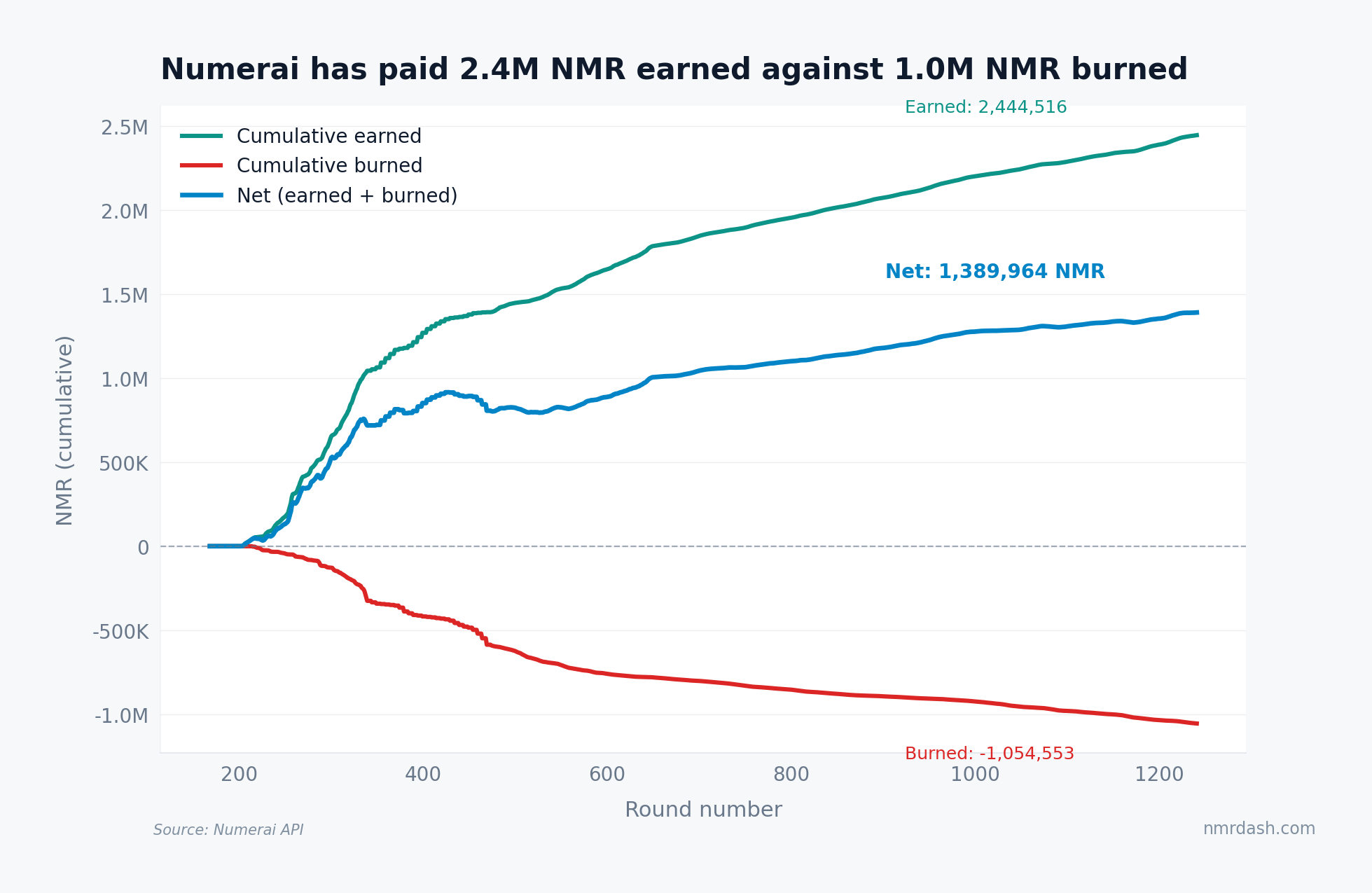
A Kaggle competition pays once. Win a typical featured competition, take $25K to $100K. Miss the prize line, take zero. Numerai is the opposite shape: 237 rounds resolved in the last 12 months produced 241,374 NMR of gross earnings against 127,551 NMR of burns, then started again. A model running on Numerai for two years sees its stake adjusted around 470 times; a Kaggle competitor’s cash outcomes depend on the small number of prize competitions they enter and finish near the top of.
Audience size: weekly skin-in-the-game vs one-shot prize hunting
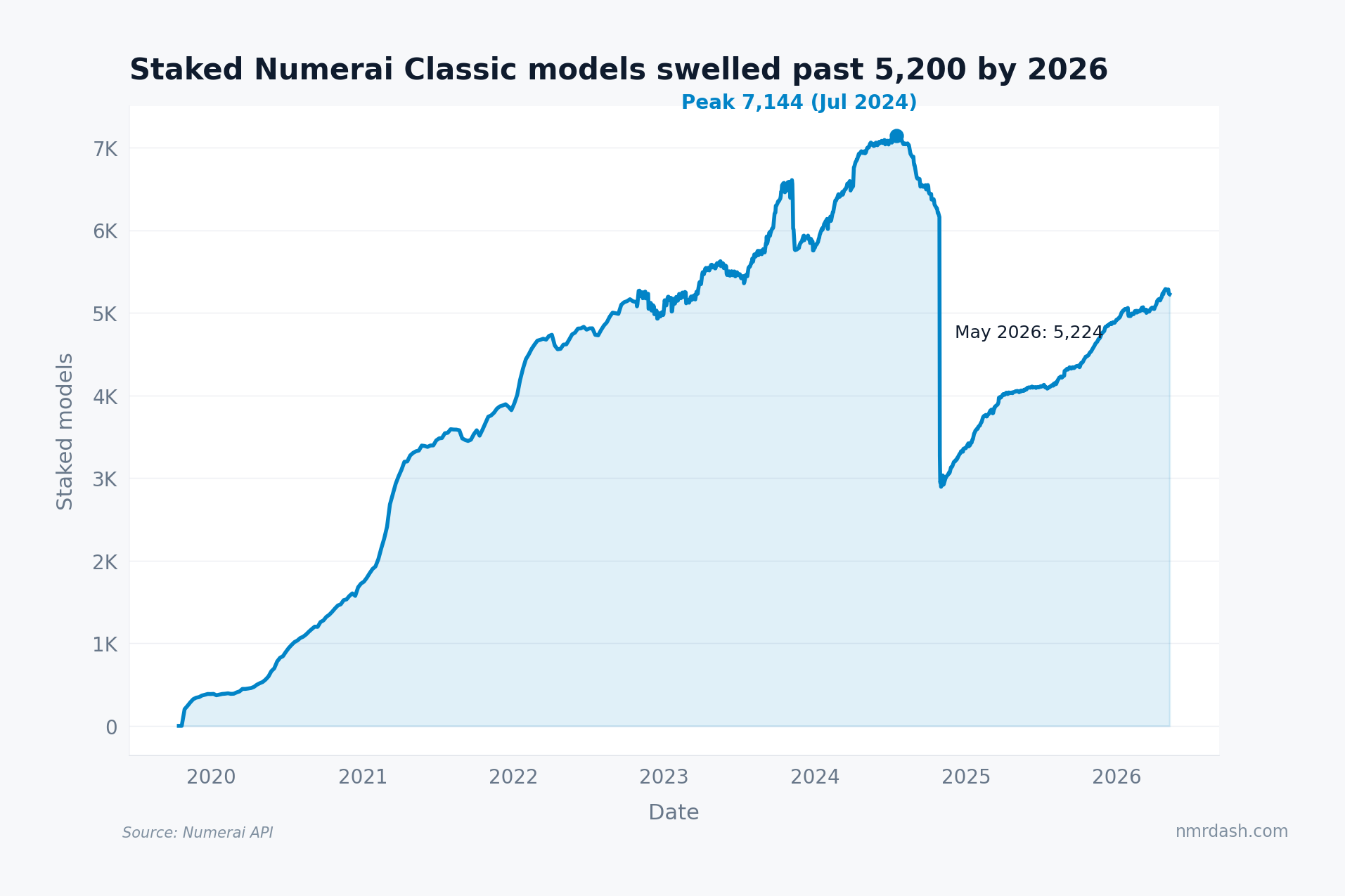
Numerai had 5,271 staked models on its most recent count and 14,378 distinct models that submitted at least one resolved prediction in the last 12 months. Both numbers grew from under 200 in 2019, peaked at 7,144 in July 2024, and rebuilt after a late-2024 cleanup that cut the staked count from about 6,300 to 2,900 overnight.
Kaggle has millions of registered users, but the cohort that actually competes for prize money on a given featured competition is a few thousand teams. The active competitor counts are within an order of magnitude. The difference is what those competitors are putting up. A Kaggle entrant risks compute and time. A Numerai staker risks NMR, usually 50 to several thousand tokens, and gets paid or burned several times a week as rounds resolve. Skin-in-the-game changes who shows up. The model participation chart separates submitting models with and without stake; stake-weighted age is a separate historical study.
Per-model earnings: a fat-tailed lottery either way
Among the 14,378 models that submitted in the last year, only 2,641 finished with positive net payout. Using the article’s $9.02/NMR reference price, the median positive earner pulled 0.1 NMR, roughly $1. The 90th percentile cleared 26 NMR ($235), the 99th cleared 1,001 NMR ($9,029), and the top earner pulled 31,771 NMR ($286,577).
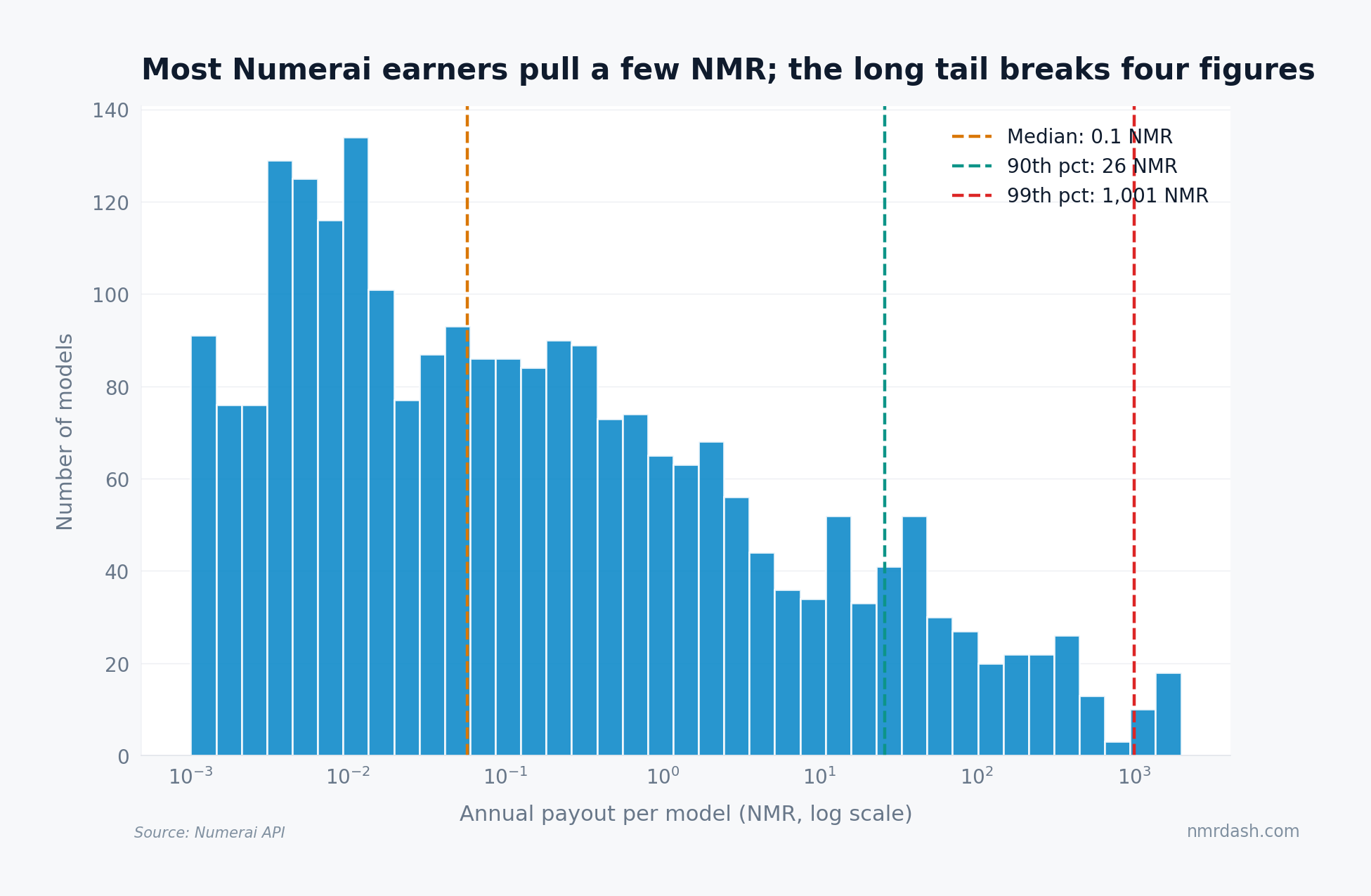
Kaggle’s distribution looks similar in shape. Most competitors leave with a public-leaderboard rank and zero dollars; a handful who podium take five-figure or six-figure prizes. The difference is what “below the prize line” means. On Kaggle, sub-podium is zero. On Numerai, sub-podium is a small payout, a small burn, or near-zero, but never a clean zero, because stake interacts with score every round. That changes what failure feels like for the median participant. Payout Gini breaks the inequality down further.
The top-100 ladder
Numerai’s top-100 earners last year took home 127,703 NMR, about 90% of the positive-earner pool of 141,987 NMR. The shape of the ladder is the interesting bit.
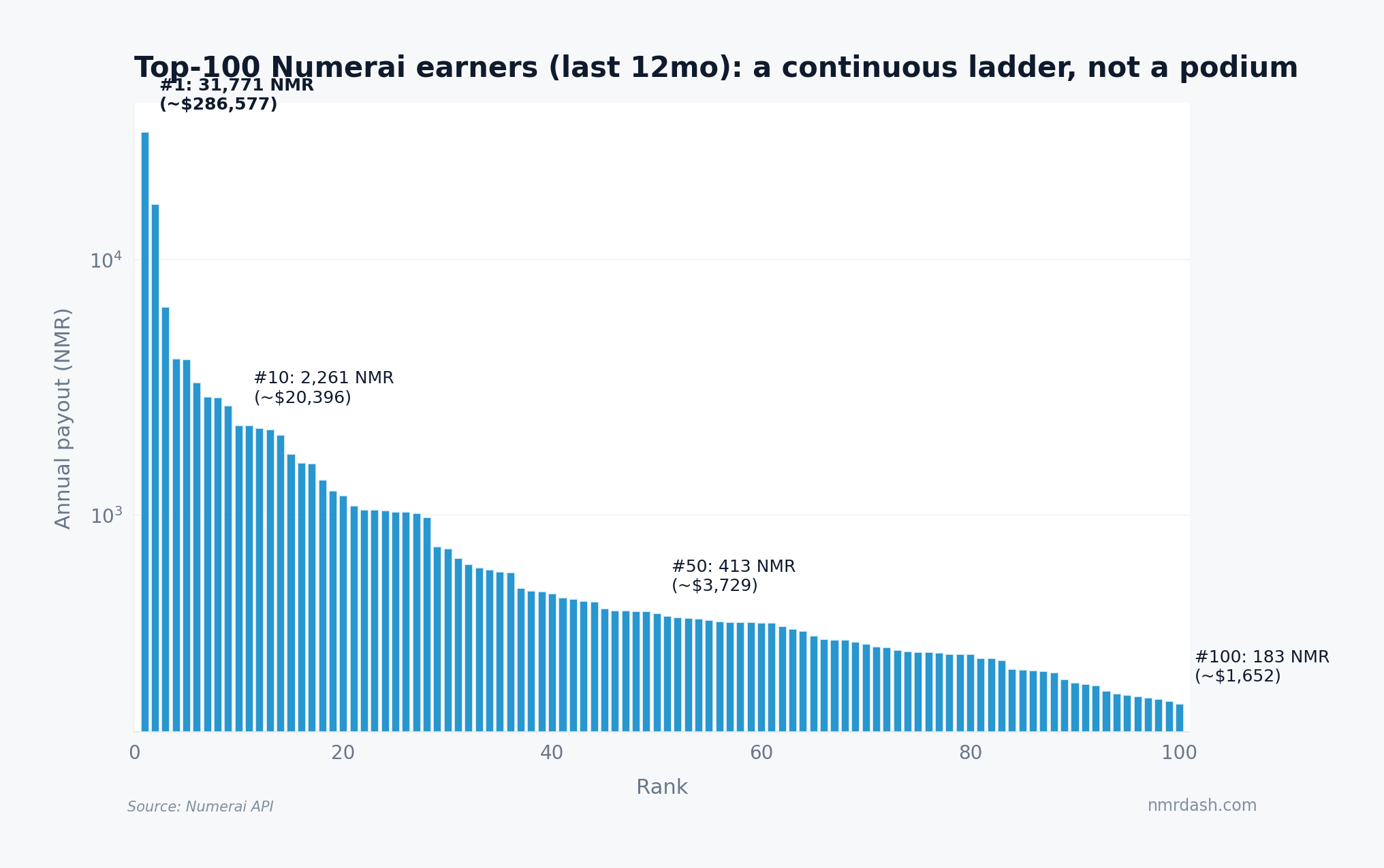
At the article’s $9.02/NMR reference price, rank 1 took 31,771 NMR ($286,577), rank 10 took 2,261 NMR ($20,396), rank 50 took 413 NMR ($3,729), and rank 100 took 183 NMR ($1,652). That is a continuous staircase, not a podium. A typical Kaggle featured competition pays five to ten finishers, with prize money concentrated in the top three and zero below the cutoff. Numerai pays from rank 1 down through several thousand at gradually shrinking amounts. A model outside the top 100 can still earn nonzero NMR, but the payout tail falls quickly.
Which platform pays you
Pick by cashflow shape, not by total dollars. Kaggle suits people who want a deadline, a cleaner objective function, and a chance at a big check. The work is intense, finite, and binary: most participants get nothing, a few get a lot. Numerai suits people who want to compound. The historical payout distribution was highly uneven; future payments still depend on new predictions, the applicable policy and realized scores.
The trap on either side is the same: confusing “I built something that scored well” with “I will be paid”. Kaggle pays only when you finish near the top of the prize list. Numerai pays when your stake survives the burns. Both are tournaments where the median outcome is roughly zero. The round economics article explains the burn-and-earn arithmetic; the dashboard’s staking return distribution shows a recent settled sample by stake tier.