· 13 min read
Numerai’s Unity Reset Kept the Stake and Lost Most Models
Numerai replaced Classic’s dataset, target and payout scores on November 6, and I read the first eleven rounds as a reset that kept most of the money and lost most of the models. Submissions fell 81% overnight. The NMR staked on a round fell 36%. Two weeks later, round stake is back to 80% of its earlier level while submissions are at 38%.
The new payout scores, NCORR and NMMC, have at most seven scored days out of sixty. They cannot yet say whether the tournament is predicting well. The older rounds can: all 50 rounds staked under the August rules are tracking a positive return, and the first of them settles on November 25.
So there are two tournaments to assess for the next three months. One is the outgoing 60-day system, which is about to deliver its first results. The other is the neutral system, whose rules I can describe but whose outcomes I cannot yet measure.
Three payout regimes in eleven weeks
Classic has changed its payout rule twice since late August. The round configurations published through Numerai’s API show each boundary:
| Setting | Through round 1342 | Rounds 1343–1392 | From round 1393 |
|---|---|---|---|
| Opened | Until August 27 | August 28–November 5 | November 6 onward |
| Target | Ender, 20 days | Ender, 60 days | Jupiter, 60 days |
| Payout scores | 0.75 × CORR20 + 2.25 × MMC | 3 × CORR60 + 15 × MMC60 | 8 × NCORR + 32 × NMMC |
| Stock universe label | BIG_UNIVERSE | BIG_UNIVERSE | GIANT_UNIVERSE_V2 |
| Return bounds | ±5% of shared stake | ±100% of round stake | −100% to +200% of round stake |
| Churn penalty | None | None | From round 1399 |
The August change was the move to atomic staking and 60-day payouts, covered in the atomic staking study. The November change is larger. It arrived with a new dataset called Unity, which Numerai released on October 16 as Classic v6 and Signals v3.1 together. The Unity announcement set November 6 as the date when all models had to use it.
Unity has 1,040 features and real stock identifiers, against 3,555 obfuscated features in the previous Classic data. Numerai’s stated reason is that the new data “allows agents to work on the whole problem”: participants can now join outside data and build their own features. The November monthly update confirmed the 8 and 32 payout weights.
Round 1393 also dropped every older score. Its configuration lists NCORR, NMMC, an informational benchmark score called NBMC, and nothing else. CORR20, CORR60, MMC, feature-neutral correlation and correlation with the Meta Model are no longer computed for new Classic rounds. The metrics cheatsheet describes those scores for the rounds that still carry them.
Neutral scores remove known risk before measuring skill
NCORR is the correlation between a neutralized prediction and the Jupiter target. Neutralizing means regressing the prediction on a set of known risk exposures and keeping only the remainder. Numerai publishes those exposures as a 300-column neutralizer matrix. It does not itemize the columns.
The practical effect is that a model no longer earns correlation for exposures Numerai already knows how to hold or hedge. Numerai’s open-source scoring code describes NCORR as the older correlation “without the 1.5 power and with a neutralization step”. The older score gave extra weight to a model’s most extreme predictions. NCORR does not.
NMMC is the neutral version of meta-model contribution. Both the prediction and the Meta Model are neutralized, the prediction is then stripped of its overlap with the Meta Model, and the remainder is scored against the target. The CORR and MMC guide explains the general idea. The Classic reference is now a new Meta Model built from Unity submissions.
A third element starts with round 1399. Neutral churn measures how much a model’s neutralized predictions change from one submission to the next. The staking documentation gives the rule: positive payouts are untouched up to a mean churn of 0.1 and are cut to about 54% at 0.2. Burns are never reduced. A model whose rankings change too fast to trade keeps its losses and gives up its gains.
Signals went first. Its payouts moved to NCORR and NMMC at round 1363 on September 25, with weights of 0.5 and 2 under its older shared-stake system. Numerai’s October update said those weights were “designed to produce historically comparable median payouts”. I have found no equivalent statement for Classic’s 8 and 32.
Unity removed four in five submissions overnight
The dataset requirement had an immediate cost. Numerai deleted every earlier Classic dataset and deactivated models uploaded against them, so a model that had run unattended for years stopped on November 6.
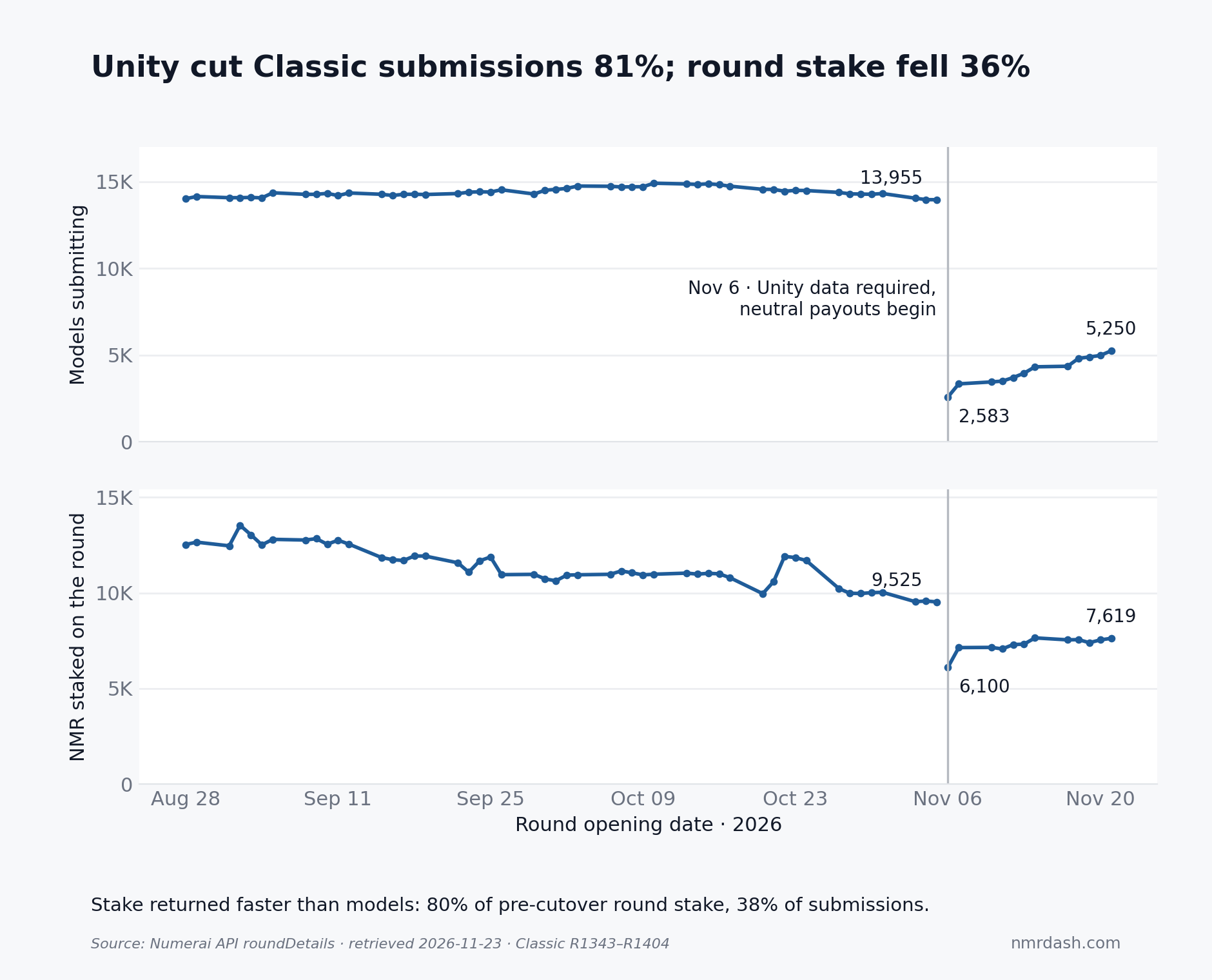
Round 1392, the last under the old data, received 13,955 submissions. Round 1393 received 2,583. By round 1404 on November 21 the count had recovered to 5,250. Fewer than half of the models in round 1399 had submitted to round 1392; most of the rest were model IDs absent from the last five legacy rounds. Numerai raised model slot limits tenfold in the same period, so a model count is a weak proxy for the number of people.
Stake behaved differently. Round stake fell from 9,525 NMR to 6,100 and recovered to 7,619 within eleven rounds. Models that had held 64% of round 1392’s stake were staked again by round 1399. The money is concentrated enough that a small number of returning accounts restores most of it, which matches the pattern in the account concentration study.
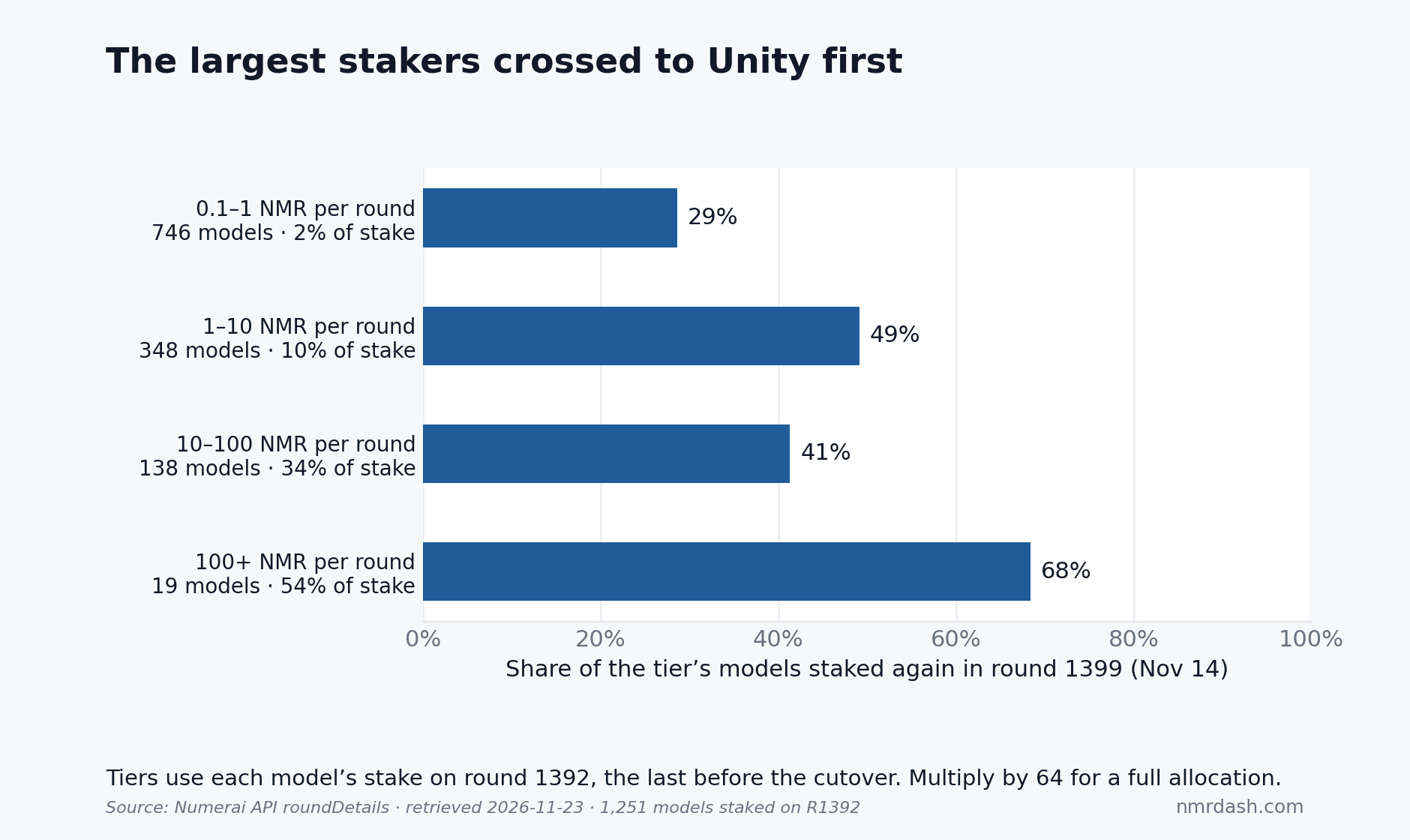
Nineteen models staked at least 100 NMR on round 1392 and held 54% of its stake. Thirteen of them were staked again eight days later, and their stake stood at 96% of that tier’s earlier total. Among the 746 models staking less than 1 NMR per round, 29% had returned.
Stake coming back does not show that the same predictions came back. Every returning model had to be retrained or rebuilt on different features, against a different target and a different stock universe. The Meta Model that Numerai trades from Classic is now an ensemble of fewer than four in ten as many submissions, each of them weeks old.
An earlier drop in the staked-model count has a different cause. Staked models fell from 4,241 in round 1351 to 1,276 in round 1352 on September 10, while round stake barely moved. Numerai later confirmed a minimum of 0.1 NMR per round for atomic stakes. That removed dust positions, not capital.
The outgoing rules are about to pay
The 50 rounds staked under the August rules are still open, and their scores are far enough along to read. Round 1343 had 57 of its 60 scoring days as of the scores published November 20.
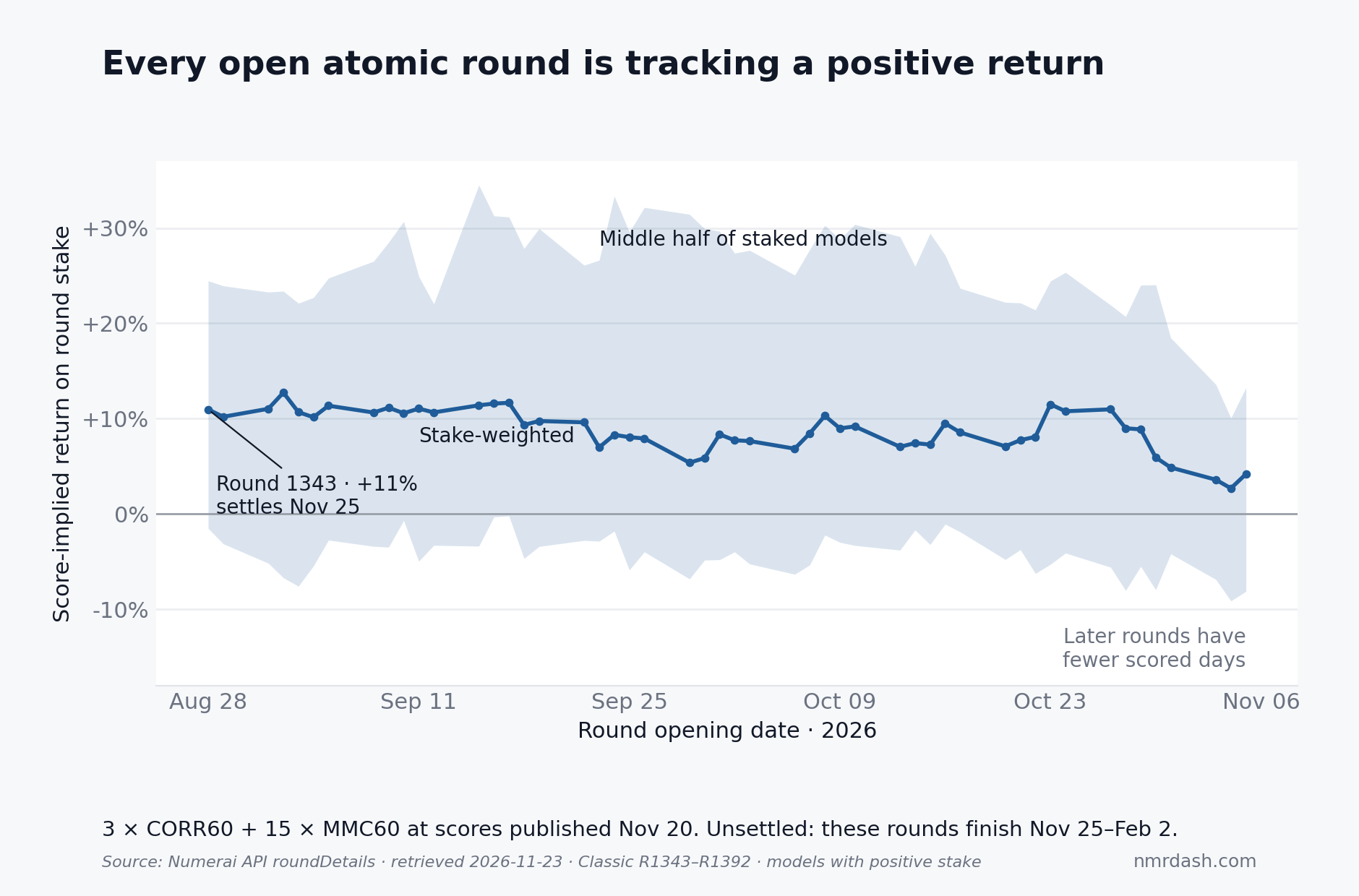
Applying 3 × CORR60 + 15 × MMC60 to each staked model’s current scores, round 1343 implies a stake-weighted return of about 11% on the NMR staked to it. The nine rounds nearest to settlement sit between 10% and 13%. Across all 50 rounds the implied total is about 50,800 NMR on 568,000 NMR of round stake, or 8.9%.
Nearly all of that comes from correlation. The stake-weighted CORR60 for round 1343 is 0.036 and the stake-weighted MMC60 is close to zero, as it should be when contribution is measured against the stake-weighted ensemble itself. Numerai’s own Meta Model shows a CORR60 of 0.055 on that round, and a positive CORR60 on all 50.
Three cautions apply. These are scores, not settlements: nothing has been paid, and later rounds have as few as eight scored days. The rounds overlap heavily, so 50 positive rounds are closer to one favorable stretch of market history than to 50 independent results. And a round return is earned on one position. With 64 positions open at a time, an 11% round return is about 0.17% of a fully deployed allocation.
Within those limits, the last weeks of the old system were good ones for the stake-weighted ensemble. In round 1343, 73% of staked models have a positive implied return.
The new weights double the swing on each round
The neutral payout weights are 2.7 times the old correlation weight and 2.1 times the old contribution weight. Whether that makes outcomes larger depends on how big neutral scores turn out to be. Classic has no settled neutral history, and Numerai has said it will not backfill one.
Signals does have one. Its models have carried neutral scores since well before they paid, and rounds 1300 to 1340 are final. Numerai says the targets and neutralizers are now “exactly the same” in both tournaments, so those scores are the closest available guide to the size of NCORR and NMMC at maturity.
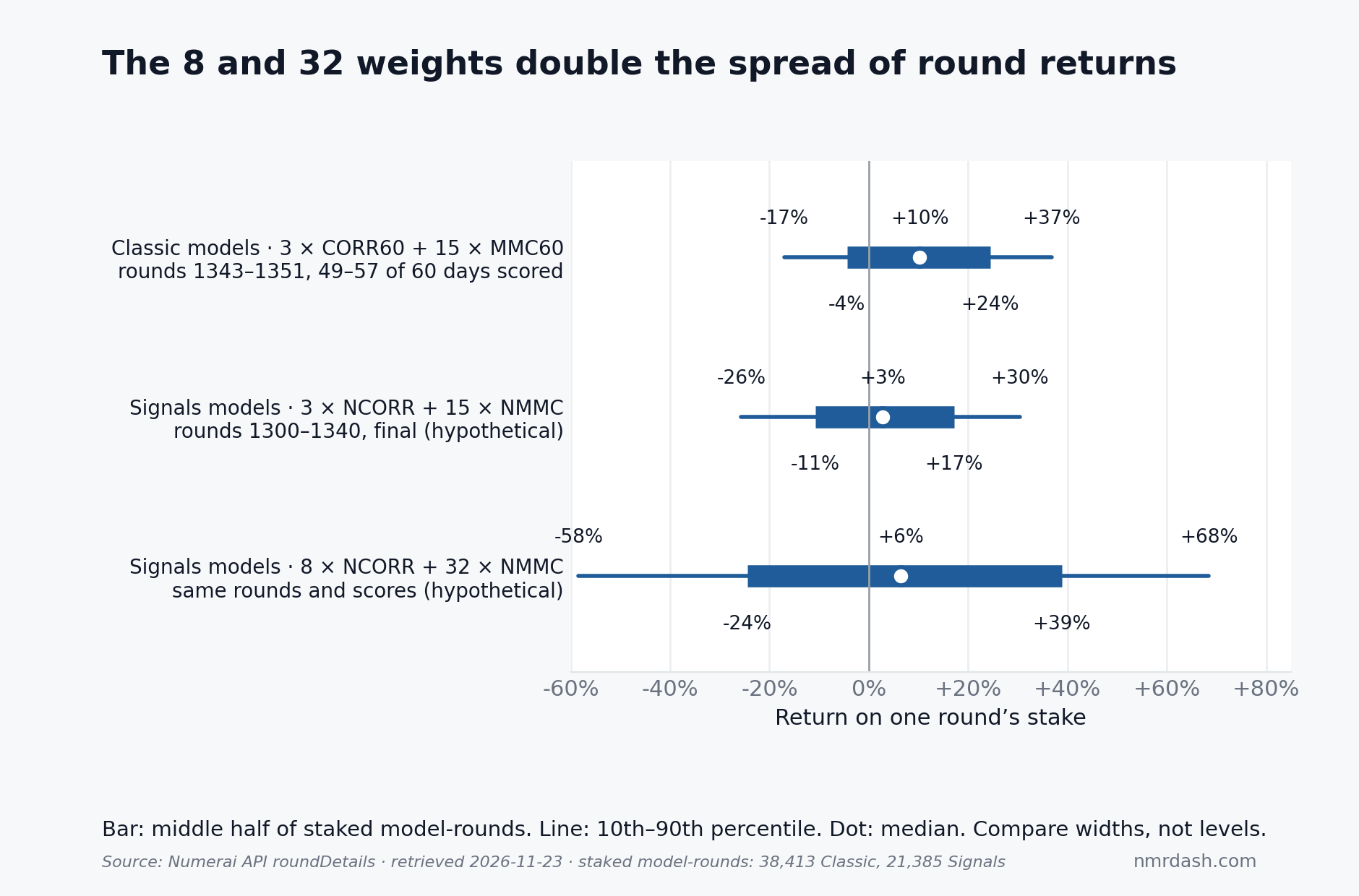
Under the August weights, the middle half of staked Classic model-rounds spans 28 percentage points of round return. Signals neutral scores under those same weights also span 28 points. Under 8 and 32 they span 63 points, from a 24% loss to a 39% gain. One in ten falls below a 58% loss, and 2.8% reach the full 100% burn.
This is a statement about width only. The Signals models, their Meta Model and the period all differ from Classic today, so the chart does not say which rule pays more. It says that if Classic’s neutral scores resemble Signals’ in size, each round’s result will swing about twice as far as it did under the rule it replaced.
Contribution carries most of that swing. In the Signals history, the 32 × NMMC term has a middle-half range 2.4 times as wide as the 8 × NCORR term. A model’s return will depend mainly on whether it adds something the Unity Meta Model lacks, measured against a Meta Model that is itself only weeks old.
The asymmetric bounds matter less than they look. Raising the payout cap to 200% affects almost no one: 8 of 21,385 Signals model-rounds would have reached it. The burn cap is the binding one.
What the first neutral scores can and cannot say
As of November 23, the Meta Model has neutral scores on five Classic rounds and fifteen daily observations in total. Its NCORR readings range from −0.033 to +0.036. Rounds 1393 and 1394 show no Meta Model neutral score at all yet, although individual models on those rounds do have scores.
I would not read direction into any of this. A 60-day score with three scored days mostly reflects three days of market noise. The dashboard’s 60-day chart now continues with NCORR from round 1393, and the join between the two series is a change of definition, not a change in performance.
The useful early observation is structural. In these first days NCORR and NMMC are nearly the same number across models, with a cross-model correlation between 0.90 and 0.99 on each round. That is expected while the Meta Model’s own score is near zero, and it should loosen as scores mature. If it does not, the two payout terms are measuring one thing twice.
The rules will change again on January 1
Numerai has already announced the next revision. Its tournament roadmap says NBMC will replace NCORR in the payout formula for rounds starting January 1, 2027, with weights still to come. NBMC measures contribution beyond Numerai’s own benchmark model. The stated reason is direct: “we are paying people for alpha that is trivial to generate”.
The same date merges the tournaments. Signals’ last round is 1432 on December 31. From round 1433, Signals and Classic models submit to the same rounds, are scored against one Meta Model and stake through atomic positions. Open Signals rounds finish under Signals rules through about the end of March.
The roadmap also narrows the agenda. Stablecoin staking, still unimplemented when I wrote in September, is paused. So is the proposed Risk tournament, after internal tests found that better risk estimates “didn’t help very much”. Crypto is unaffected by the merger and is slated to run seven days a week.
Two operating notes belong in the record. Numerai reported NMR payouts worth $301,531 for September and $172,243 for October. And on November 3 it said an exploiter had taken 127,141 NMR from Binance and sold it, while stating that Numerai’s treasury, hot wallet and user funds were safe. I have found no fund asset or performance figure published by Numerai in this period.
What would change my reading
My view is that Numerai accepted a sharp loss of breadth to get a tournament that pays for neutral, tradeable, non-trivial predictions, and that the stake data so far say the largest participants went along. Whether the smaller Meta Model is a better one is not yet observable.
The first check is November 25. If round 1343 settles near the 11% its scores imply, the 60-day atomic system worked as designed in its first cycle. A material gap between scores and settlement would point to a mechanism I have not accounted for.
The second is participation by the end of December. Submissions that level off well below 14,000 would mean the long tail of legacy models is gone for good. That matters less for stake than for the diversity of the Meta Model. Round stake that stops short of its earlier 9,500 NMR would mean some capital left with them.
The third arrives in early February, when round 1393 resolves. I would compare the spread of settled neutral returns with the 63-point range above. A much narrower result would mean Classic’s neutral scores are smaller than Signals’, and that the larger weights were sized to offset that. A similar or wider one would confirm that stakers now carry about twice the per-round risk, three weeks after the payout scores changed again.
Sources and method
Research date: November 23, 2026. Round configurations, submission counts, round stake and model scores come from Numerai’s public API (rounds, roundDetails and submissionScores), retrieved that day; model scores were last updated November 20. Classic coverage is rounds 1325–1404, with model rosters through round 1399. Signals coverage is rounds 1300–1342, 1355–1370 and 1388–1404.
Implied returns apply each round’s configured multipliers and bounds to the scores of models with positive stake. They are not settled payouts. Stake-weighted figures weight each model by its stake on that round. The spread exhibit pools staked model-rounds: 38,413 from Classic rounds 1343–1351 and 21,385 from Signals rounds 1300–1340. The Signals rows apply Classic multipliers to Signals scores and are hypothetical; Signals paid those rounds under different scores, a 3.5% clip and a payout factor below one. No churn penalty is applied in any exhibit. Retention tiers use stake on round 1392 and count a model as returned if it had positive stake on round 1399. Model IDs are not accounts. Download round-level data.
Numerai’s announcements and documentation are linked at each claim. Metric definitions follow the Classic and Signals scoring definitions and the neutral_correlation and neutral_contribution functions in numerai-tools. Numerai’s Classic scoring pages still described the round 1393 change as planned on the research date; the API shows it in effect.