· 4 min read
Numerai Hedge Fund Performance: What Public Filings Reveal
Updated
Historical scope reviewed September 8, 2026. Only explicitly reported fund-return observations describe fund performance. Changes in 13F value and tournament scores are proxies with different meanings. Fund performance does not contractually determine staking ROI or give NMR holders a claim on fund assets. See the current metric definitions.
This study does not contain a continuous public NAV or audited fund-return series. Isolated return announcements, when available, require their own dates and methodology; they cannot be reconstructed from holdings filings. What does exist is a paper trail of mandatory SEC disclosures (quarterly 13F holdings reports and Form ADV registrations), and that trail says a lot about the fund’s trajectory even if it cannot give you a Sharpe ratio. This article works through what those filings show, and just as importantly, what they cannot show.
Numerai, founded by Richard Craib in 2015, runs market-neutral equity strategies built on the stake-weighted meta-model crowdsourced from its tournament. The fund files as Numerai GP LLC with the SEC, which makes two datasets public: every quarter, a 13F listing its long US equity positions, and periodically, a Form ADV reporting regulatory assets under management.
The Long Book Grew ~7x in 14 Quarters
The 13F series is the cleanest growth signal. Numerai’s first filing, for 2022 Q4, disclosed $146.6M of US long positions. The most recent, for 2026 Q1, disclosed $997.3M, a 6.8x increase across 14 consecutive quarterly filings.
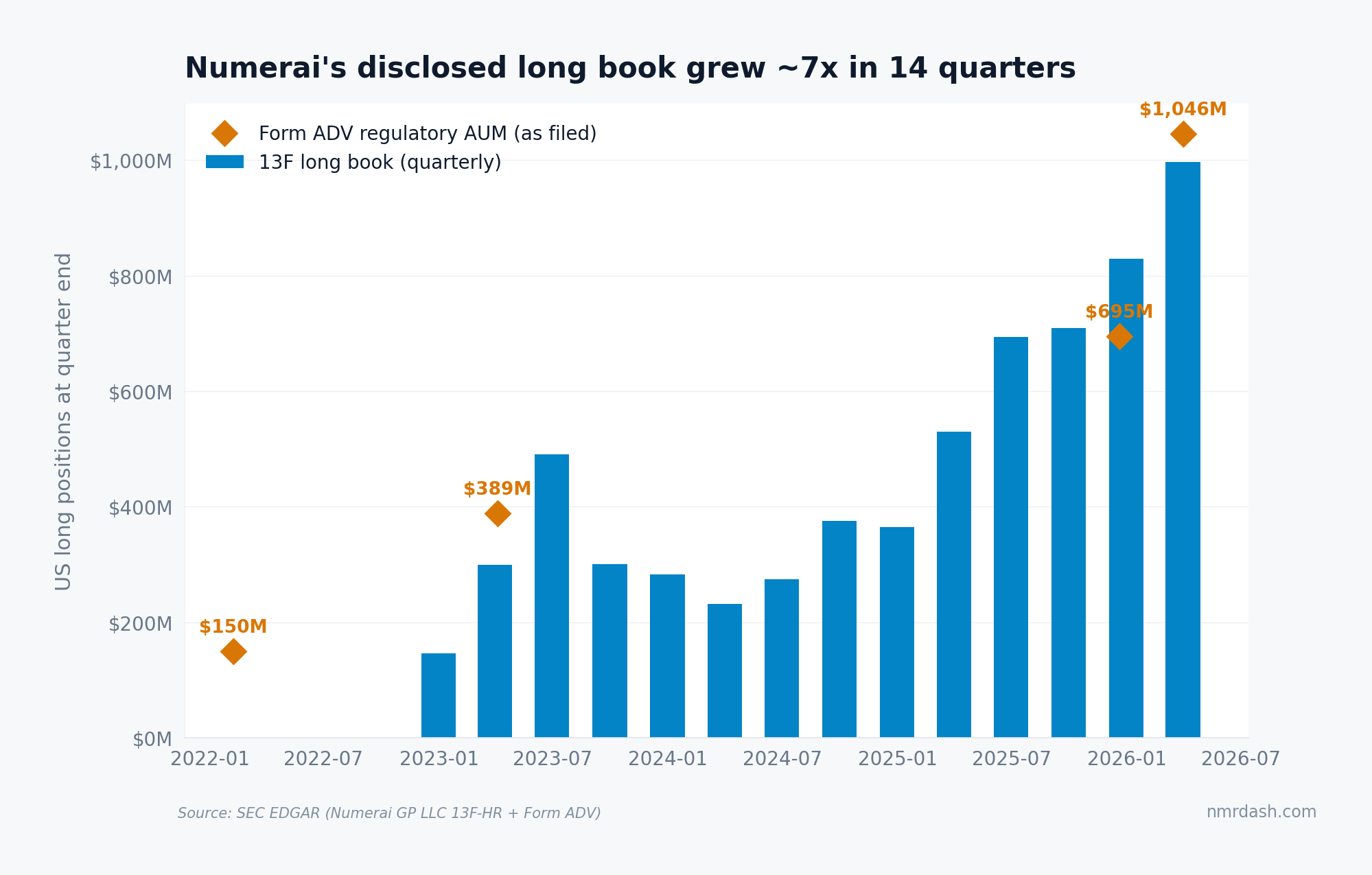
Form ADV tells the same story from a different angle. Regulatory AUM was $149.7M in early 2022, $388.8M by April 2023, $695.5M in the late-2025 filing, and $1.05B as of the April 2026 amendment. Advised accounts (the funds and vehicles the adviser runs) grew from 1 to 11 over the same span. Note that regulatory AUM is a gross figure that can include leverage; it is not investor capital or net asset value. The quarterly AUM breakdown covers this series in more detail.
Growth Was Not a Straight Line
Quarter-over-quarter changes in reported long positions measure changes in disclosed exposure: they mix trading gains and losses with subscriptions, redemptions, and gross-exposure changes. There is no way to separate the components from the outside.
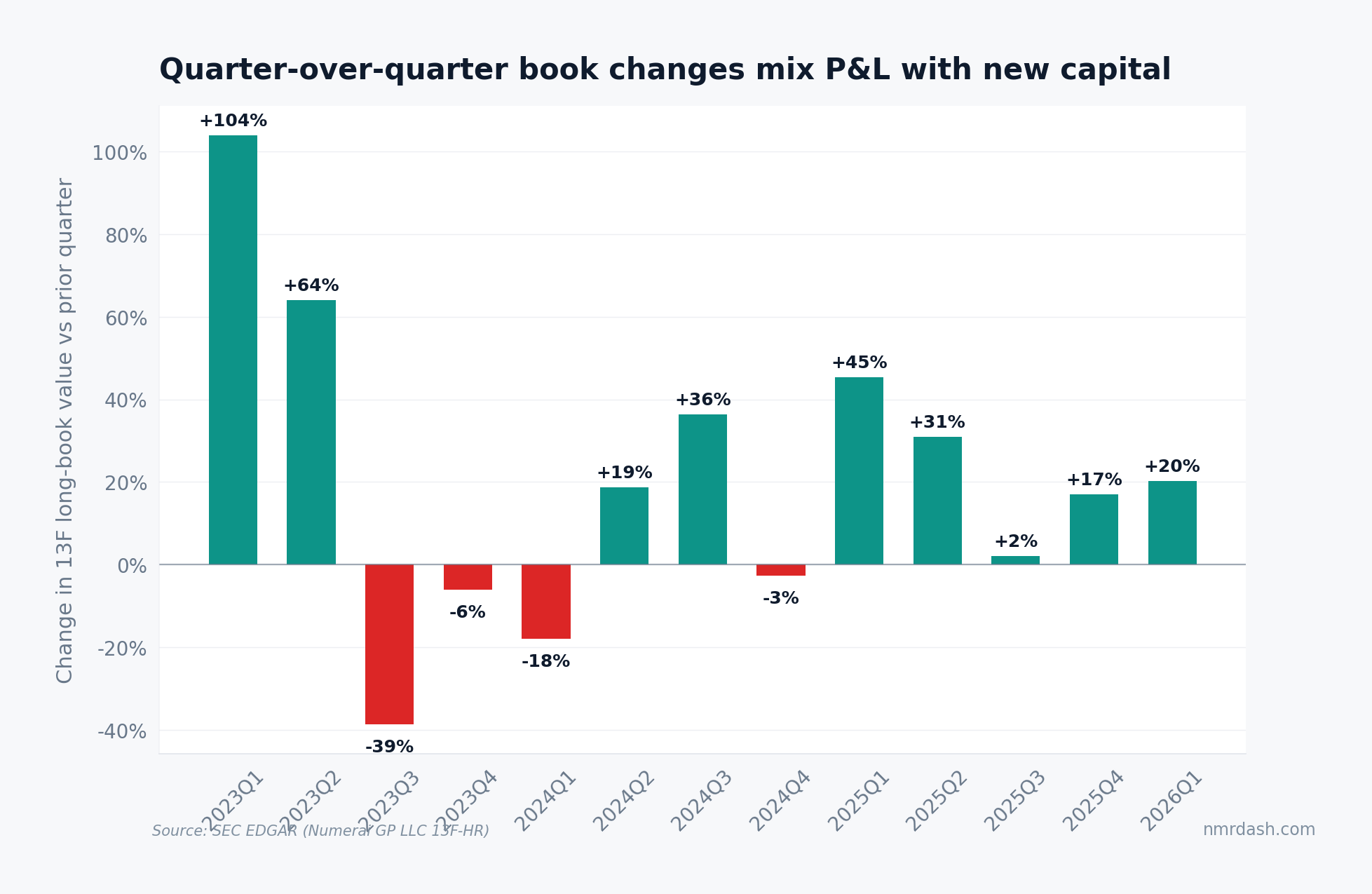
Reported value fell from $490M at 2023 Q2 to $232M at 2024 Q1, a 53% decline over three consecutive down quarters (-39%, -6%, -18%). The filings do not separate market moves, investor flows, exposure changes and changes in reportable holdings. This is not a measured investor drawdown. What is knowable is the recovery: seven of the eight quarters since have been positive, and the book has more than quadrupled from that trough.
Fund assets and NMR have different economic meanings
The former figure dividing 13F value by NMR market capitalization has been removed. Reportable holdings are gross asset positions; token market capitalization values circulating tokens. Their ratio does not establish token backing, a claim on fund assets, participant yield or whether NMR is cheap. Staking rewards depend on the applicable tournament payout policy.
Where the Growth Went: Breadth, Not Size
The portfolio’s construction is visible too. Position count grew from 111 holdings in the first filing to 746 in the latest, while the average position size stayed almost exactly flat: $1.32M then, $1.34M now. Numerai scaled by adding names, not concentrating bets, consistent with a systematic market-neutral book where the meta-model spreads exposure across a wide universe.
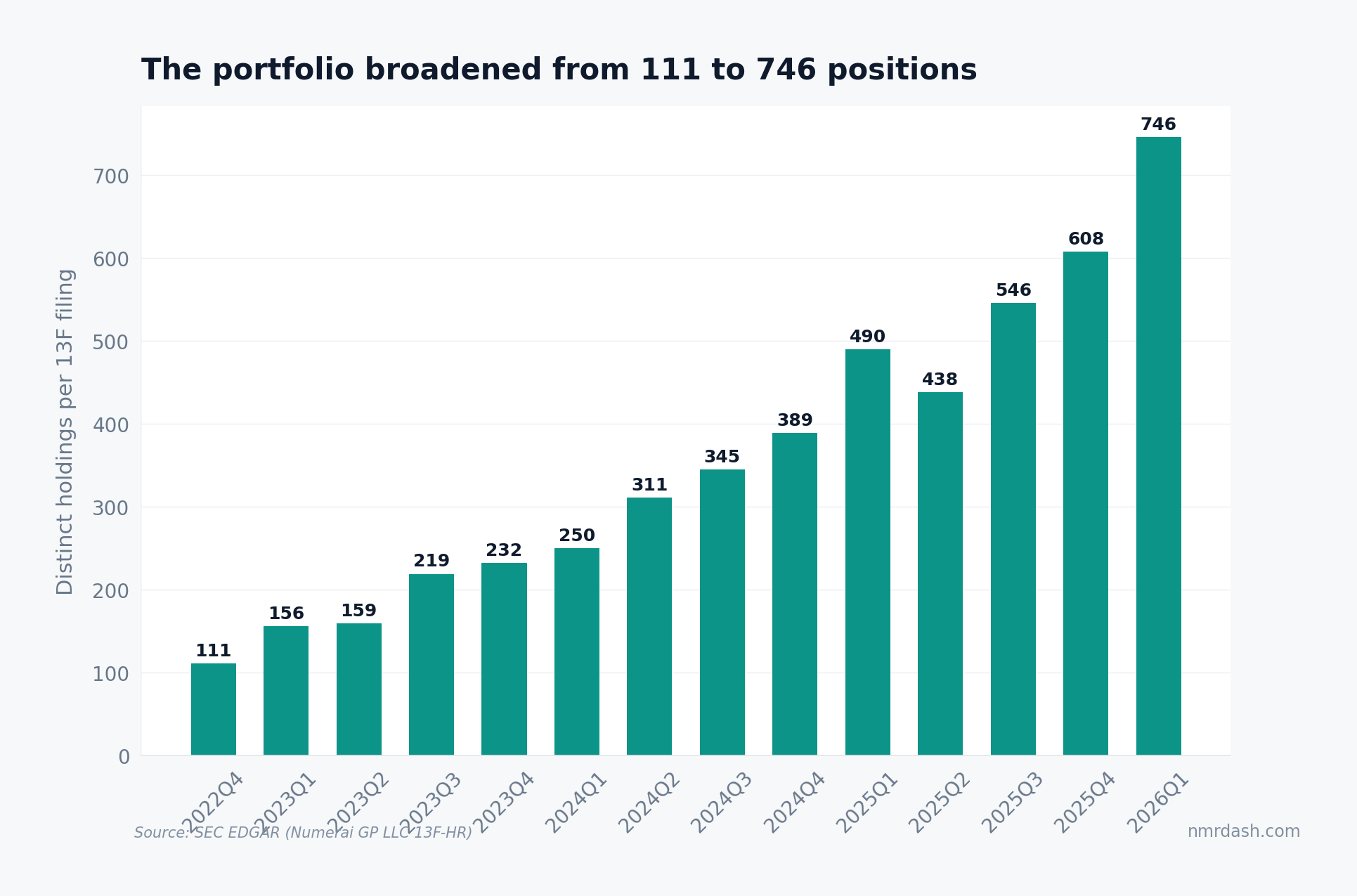
The dashboard tracks quarterly reported 13F holdings value. Concentration, individual positions and holdings persistence are analyzed within the historical sample in Inside Numerai’s 13F.
What the Filings Cannot Tell You
Every number above deserves its caveats, and they are not small:
- 13Fs show longs only. Numerai runs market-neutral strategies, but the filings do not report the full short side, cash or all other exposures. They do not establish what fraction of total exposure is omitted.
- Notional is not NAV. A $997M long book at, say, 2-3x gross leverage implies far less investor capital than the headline suggests.
- Flows and returns are entangled. A +20% quarter could be strong performance, new capital, or added leverage.
- Regulatory AUM is gross. The $1.05B ADV figure includes leverage and is not comparable to the “AUM” a fund would market.
The observed filing series establish growth in reported assets and position breadth. They do not establish the sign or magnitude of investment returns. For how the fund’s growth relates to what tournament participants actually earn, see Is Staking on Numerai Profitable? and the SEC institutional footprint analysis.